

Last updated: Wednesday 1 July 2026
In a hurry? TL;DR
- 5x: best for daily makeup detail, light brows, shaving checks and anyone who wants clarity without feeling too close.
- 7x: the useful middle ground for brows, lash corners, contact lenses, stray hairs and quick grooming checks.
- 10x: good for short precision only. Helpful for one brow hair or one lash edge, too intense for a full routine.
- 15x: specialist territory. It can help with tiny tasks, but it often exaggerates texture and encourages over-correction.
5x vs 7x vs 10x vs 15x: the quick decision table
| Magnification | Best for | Use with caution if | Best LUNA fit |
|---|---|---|---|
| 5x | Daily eyeliner, mascara checks, concealer edges, light brow shaping and comfortable close work. | You need very precise detail for one tiny area. | Use as the comfort benchmark before going stronger. |
| 7x | Brows, lash corners, contact lens insertion, beard edges, stray hairs and detail checks that need a little more help. | You want to judge your whole face, foundation, blush or skin texture. | ORBIT for home detail, COMPACT 2.0 for portable 7x checks. |
| 10x | Short, controlled precision: tweezing one hair, placing a lash edge, checking a beard corner. | You dislike leaning in or you tend to over-tweeze. | Useful as a specialist secondary mirror, not the main view. |
| 15x | Tiny, single-task checks such as a splinter, ingrown hair or very low near-vision support. | You are doing makeup, brows or shaving for more than a minute or two. | Usually too strong for LUNA’s daily-use philosophy. |
How magnification really works for makeup, grooming and ageing eyes

Most people search “5x vs 10x vs 15x” assuming higher magnification must be better. That is the weak assumption to challenge first. Magnification changes more than size: it changes working distance, field of view, distortion risk and how stable you need to be inside the mirror’s sharp sweet spot.
If you have tried a strong magnifying mirror and thought “why do I have to get so close?”, that is not a fault. It is how high magnification behaves. It can be brilliant for a 30-second job and maddening for a 10-minute routine.
Age can make this feel more dramatic. Mayo Clinic describes presbyopia as the gradual loss of near focus that usually becomes noticeable in the early to mid-40s and continues into later life. Harvard Health also notes that the magnification support people need can change over time. That does not mean you automatically need 15x. Often, it means you need better light and a moderate close-up view.
⚡ PRO INSIGHT: Before buying stronger magnification, test lighting first. Stand where you normally get ready and use the brightest, most even front-facing light you have. If detail suddenly looks easier, your issue was not only zoom, it was poor visibility.
Which magnification should you actually choose?
Choose the lowest magnification that solves the real task. That sounds boring, but it avoids most bad mirror purchases.
Choose 5x if you want comfort, field of view and a mirror that does not make normal skin texture look dramatic. It is the safer everyday zone.
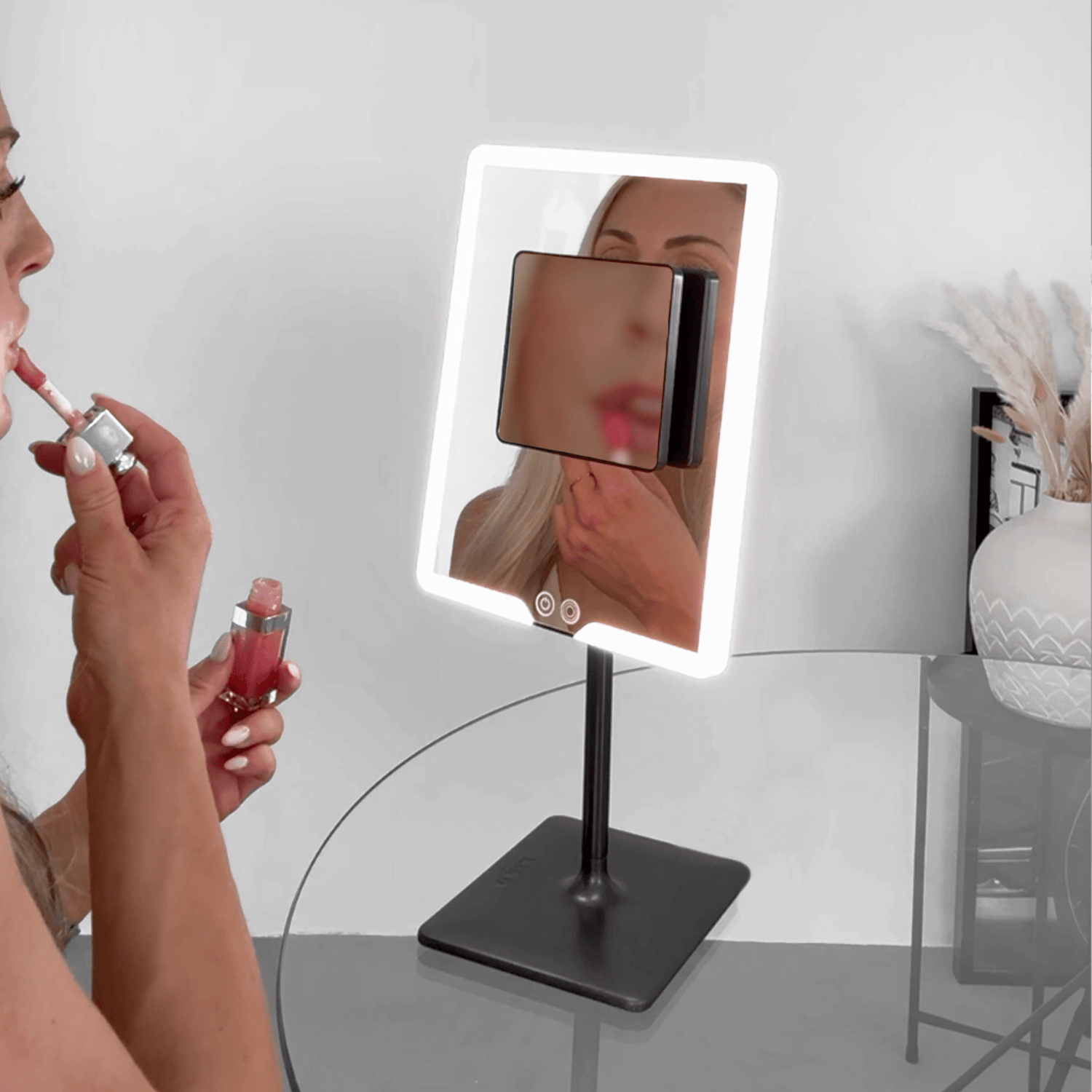
Choose 7x if you want a little more precision without turning the routine into microscope work. This is why 7x matters in the LUNA range: ORBIT includes a detachable 7x magnification add-on for detail work, while COMPACT 2.0 has a 7x magnification mirror for portable checks.
Choose 10x if you are disciplined. It is helpful for one job at a time, but it becomes unhelpful when you try to judge your whole face through it.
Choose 15x only for tiny specialist tasks. For makeup, brows and shaving, it can make you fix things nobody will ever notice in normal light.
The easy choice
Choose ORBIT if the problem is home precision
For brows, shaving lines, lash checks, contact lenses and detail makeup, the more reliable setup is a large lit 1x view with brief 7x magnification when the task calls for it.
| Best for | Brows, shaving lines, lashes, facial hair, contact lenses |
| Why it helps | Large lit mirror plus 7x magnification add-on |
| Best setup | Bedroom, bathroom or dressing table |

The trap: why stronger magnification often leads to worse results
Strong magnification makes small imperfections look huge. That sounds helpful, until it changes your behaviour. People over-tweeze because one stray hair looks like five. People over-apply concealer because one pore looks more obvious than it does in normal light. People shave too aggressively because they keep chasing a perfect edge that only exists at 15x.
Use this rule instead: plan in a realistic view, then check detail briefly. Do the main work in a normal 1x mirror with good lighting, then dip into magnification for final precision. If you want to understand how light affects the same routine, read the LUNA guide to daylight makeup and the indoor vs outdoor light gap, then compare it with warm, cool and natural light for makeup.
“Let’s consider your vision correction options.”
This phrasing from optometrist Josie Evans is useful because it reframes close-up difficulty as a setup and support question, not a reason to jump straight to extreme magnification.
Ageing eyes: light first, then magnification
If you are 45 to 64 and close work has become annoying, your instinct might be “I need 15x”. Pause. Clinical guidance from Cleveland Clinic explains that presbyopia is diagnosed through an eye exam and corrected with options such as glasses, contact lenses or other treatments. A mirror is not a medical fix. It is a practical routine tool.
The smarter approach is: improve the light, keep the main view realistic, then add moderate magnification for the exact moment you need detail. For many daily beauty and grooming tasks, 7x is a better compromise than 10x or 15x because it gives more help than 5x without shrinking the usable view as aggressively.
⚡ PRO INSIGHT: If you are buying a magnifying mirror as a gift, especially for brows, shaving, contact lens handling or close-up makeup, prioritise bright even light and optional magnification. It feels premium because it is easier to use, not because it is extreme.
Pick the right setup by use case
| Use case | Recommended approach | Here’s Our Favourite |
|---|---|---|
|
Everyday makeup Symmetry matters |
Do most of the routine in a well-lit 1x view. Use 5x to 7x for final eyeliner, mascara and brow checks. | ORBIT, large lit view plus 7x detail. |
|
Precision grooming Brows and stray hairs |
Map the shape in a realistic view, then zoom briefly for a confirm-and-stop check. | ORBIT, paired with this guide to plucking stray hairs without pain. |
|
Shaving and beard edges Men’s grooming |
Use even light to reduce shadow lines, then brief magnification to tidy corners and missed hairs. | ORBIT, also see the men’s grooming mirror guide. |
|
Travel and bag checks Portable precision |
Use 1x for the overall check, then 7x for one small task, such as a lash edge, lip line or contact lens. | COMPACT 2.0, with more detail in the COMPACT 2.0 bag mirror guide. |
How to choose your magnification in 60 seconds
- Pick the main task. Full-face makeup, brows, shaving, contact lenses and splinter checks all need different levels of detail.
- Set your normal distance. Stand how you actually stand. If you hate leaning in, do not buy a mirror that forces you to.
- Fix lighting first. If shadows are the issue, magnification only makes shadows bigger.
- Choose the lowest useful magnification. For many people, that means 5x for comfort, 7x for useful precision, and 10x only for short checks.
- Step back before you finish. Always sanity-check in 1x. That is how you avoid over-correcting.
If you are still comparing lighting setups, this breakdown of vanity mirrors with lights vs ring lights is the better next read.

For portable precision
COMPACT 2.0 gives you 7x detail without carrying a full vanity mirror
Use it for travel touch-ups, eyebrow checks, contact lens insertion and quick grooming on the go. It is the better fit when you need magnification away from the dressing table.
Common mistakes and the simple fixes
- Mistake: using 15x as your main mirror. Fix: use 1x for the overall face, then magnification briefly for checks.
- Mistake: blaming your eyesight when the lighting is the real problem. Fix: improve front-facing light, then reassess magnification.
- Mistake: over-tweezing or over-blending because the mirror is too intense. Fix: set a two-minute magnification limit, then step back.
- Mistake: choosing 10x or 15x because it sounds professional. Fix: choose by task, not by the biggest number.
One mirror, daily use
Upgrade the mirror check you use every day
ORBIT is the premium LUNA mirror for people who want proper lighting, a larger face view and 7x detail without cluttering the bathroom with separate tools.
“The light really helped in our darker bathroom.”

Quick tracked delivery available in:
 USA
USA
 UK
UK
 EU
EU
FAQs
Is 15x magnification too strong for normal makeup?
For most people, yes. 15x shows a tiny area at a time and exaggerates texture, which can push you into over-correcting. Use it briefly for a specific check, not for full-face makeup.
Is 5x, 7x or 10x better for everyday makeup and grooming?
5x is usually the most comfortable for daily detail. 7x is the better middle ground for brows, lashes, contact lenses and grooming checks. 10x is useful for short precision tasks, but it is often too intense for a full routine.
Why do I have to get so close to see clearly in a high magnifying mirror?
Higher magnification usually demands a closer working distance and a smaller sharp sweet spot. If you dislike leaning in, choose lower or moderate magnification and improve lighting instead.
What is the best magnification for ageing eyes?
If close work is harder in your 40s to 60s, better light often helps more than jumping to extreme magnification. Many people find 5x to 7x more comfortable than 10x or 15x for everyday routines.
Is 7x closer to 5x or 10x?
7x sits between them, but in real use it often behaves like the practical compromise: stronger than 5x for detail, usually more manageable than 10x for daily beauty and grooming checks.
Does ECLIPSE have magnification?
No. ECLIPSE is a lighting-first travel mirror and does not have magnification. If you need 7x detail, choose ORBIT for a home setup or COMPACT 2.0 for portable precision.
Related links
- Do I Need a Magnifying Mirror? A 7x Zoom Breakdown
- COMPACT 2.0: Compact Mirror With Lights That Fits in Your Bag
- Daylight Makeup: Why Indoor vs Outdoor Light Changes Everything
- How to Pluck Stray Hairs Without Pain
- Men’s Grooming: Best LED Mirror for Shaving and Brows
- ORBIT Phantom Black
- COMPACT 2.0 Matte Black


Leave a comment
This site is protected by hCaptcha and the hCaptcha Privacy Policy and Terms of Service apply.