

Flattering Lighting, Not Filters: 10 Tiny Tweaks for a Fresher Look
Lighting does not change your face. It changes the shadows, contrast and colour cues people interpret as “tired” or “fresh”. The good news is you can fix most of it in minutes.

10 Small Lighting Adjustments That Make You Look Younger Instantly
“Instantly” here means instantly on your reflection and on camera, not a permanent change. Harsh overhead light can deepen under-eye shadows, sharpen texture, and push colour warmer or cooler than reality. A few small tweaks soften those effects so your face reads more even, more rested, and more like you on a great day.
Quick cheat sheet: what to change first
| Adjustment | What it helps | Fast version (30–90 seconds) |
|---|---|---|
| Lower the light to face level | Under-eye and brow shadows | Move a lamp to the side of your mirror, at cheek height |
| Diffuse a hard bulb | Harsh contrast and “tired” shadows | Aim the lamp at a wall, not your face |
| Pick one colour temperature | Sallow or overly pink tone shifts | Turn off the “odd” bulb (warm vs cool) and match the rest |
| Reduce overhead dominance | Eye hollows, deep nasolabial shadows | Switch off ceiling light, keep one front light on |
Before you start: a 15-second “shadow test”
Stand where you normally get ready. Hold your phone at arm’s length and switch between: ceiling light only, lamp only, window only. If ceiling-only makes the area under your eyes look darker or your jawline look harsher, that is not “your face”. That is top-down shadow.
Most “ageing” lighting problems are really “angle” problems. Light from above creates shadows under brows, nose and chin. Light closer to face level reduces those shadow pockets and reads more even in real life and on camera.
1) Move your main light down to face level

Overhead lighting is efficient for a room, but it is rarely flattering for a face. When light comes mainly from above, it casts shadow into eye sockets and under cheekbones. That contrast can read as “tired” even if you slept fine.
- Place a lamp beside your mirror, roughly at cheek to eye height.
- If the lamp is tall, sit it on a stack of books or a small side table.
- Keep it slightly off to the side to avoid a flat, “passport photo” look.
2) Turn the bulb into a bigger, softer light source
Soft light is basically light that wraps around your face rather than hitting it like a spotlight. You do not need studio gear for this. You just need to make the light source feel larger relative to your face.
- Aim a lamp at a pale wall to create a wide, diffused “bounce”.
- Use a lampshade (opaque or fabric, not clear glass) to reduce hard edges.
- If you use a ring light, turn it down. Bright + close can look clinical.
Expert note:
“There are no harsh shadows. It’s very, very forgiving.” – Iké Udé, artist and photographer (Vogue interview)
The point is not to erase features. It is to stop harsh shadows from doing the heavy lifting of your whole look. Source
3) Kill the “mixed lighting” problem
Mixed lighting is when one light is warm (yellow) and another is cool (blue). Your brain can handle it. Cameras struggle. It can make skin look uneven, with warmer patches and cooler patches that are purely lighting, not reality.
- Pick one dominant light source for your face.
- Turn off the odd bulb that does not match the rest.
- If daylight is coming in strongly from a window, consider switching off warm overhead bulbs.
4) Choose a sensible colour temperature (and stop guessing)
Colour temperature is measured in Kelvin (K). Warm light (lower K) can look cosy, but it can also push skin tone warmer than it is. Cooler light (higher K) can feel “clean”, but it can be unflattering if it makes shadows look harder.
A practical rule: use warm light for vibe, use neutral to daylight-leaning light for accuracy. Energy Saving Trust’s guide breaks down warm, neutral and cool bands in plain English, which is useful when you are buying bulbs or setting up a room. Energy Saving Trust lighting advice
5) Replace the “one harsh overhead” with two smaller points
Two lights at lower brightness often look better than one powerful ceiling source. Why? You are spreading illumination across the face from more than one angle, so shadows soften instead of carving deep lines.
- Try two bedside lamps either side of your mirror (even if they are not perfectly symmetrical).
- Keep both on a similar brightness level so one side does not “drop off”.
- If you only have one lamp: bounce it off a wall plus keep a small, low-brightness front light.
6) Put the mirror where the window helps you (not where it fights you)
Window light can be the most flattering light you own, but placement matters. If the window is behind you, your face is darker and the room looks brighter. If the window is to the side, you can get gentle shape without harshness. If the window is in front, it is usually the most even.
- Best quick fix: turn so the window is in front of you, not behind.
- If you cannot move: close sheer curtains to soften the light.
- In winter: window light is weaker, so you may need a soft LED assist.
7) Use the “tilt trick” to lift shadows under the eyes

If your light is fixed but your mirror is movable, tilt the mirror slightly so it catches and returns more light into the under-eye area. This is subtle, but it is one of the fastest ways to soften the shadow that makes people say “you look tired” when you feel fine.
- Tilt the mirror a few degrees upward, then lower your chin slightly.
- Check both straight-on and from a slight angle.
- Stop when you see a gentle highlight under the eyes, not glare.
“Brighter” is not automatically “better”. Too much brightness increases contrast and can emphasise texture. The better target is evenness: enough light to see detail, but soft enough to avoid hard-edged shadows.
8) Check your colour rendering (CRI) if you care about accuracy
CRI (Colour Rendering Index) describes how faithfully a light source shows colours compared with a reference. If CRI is low, colours can look dull or slightly “off”, which can make skin look less even and make grooming or makeup checks harder than they need to be.
If you are buying a bulb or choosing a light source for your mirror area, look for CRI information in the specs. The U.S. Department of Energy’s overview of colour rendering is a solid primer if you want the non-marketing version of what CRI means. U.S. DOE: colour rendering explainer
9) Remove the “top light” shadow from your bathroom
Bathrooms are the worst offenders because ceiling downlights create deep shadows exactly where you do close work. If you shave, shape brows, apply concealer, or insert contact lenses, that top-down shadow makes everything feel harder and can make your reflection look harsher.
- If you can: switch off the ceiling light and use a front light source instead.
- If you cannot: add a small lamp (or soft LED) outside the splash zone, aimed at a wall.
- Do a final “reality check” by stepping into a neutral-lit room.
If you want a deeper breakdown of why indoor light changes what you see, our guide on the indoor vs outdoor light gap is a useful companion read.
10) Add one “final check” light condition (so you stop getting surprised)
The most frustrating moment is leaving the house and realising you look different in another environment. A simple fix is to build a two-step check: do your main routine under one flattering, even setup, then check for 10 seconds under a second condition that matches where you are going (daylight, office cool-white, evening warm).
- Daytime plans: check near a window.
- Office or retail lighting: check under a neutral, brighter light.
- Evening plans: check under a slightly warmer, softer light.
Which mirror setup suits which routine?
| Routine | What you need from lighting | Here’s Our Favourite |
|---|---|---|
| Daily grooming and shaving | Even face-level light to reduce top-down shadows |
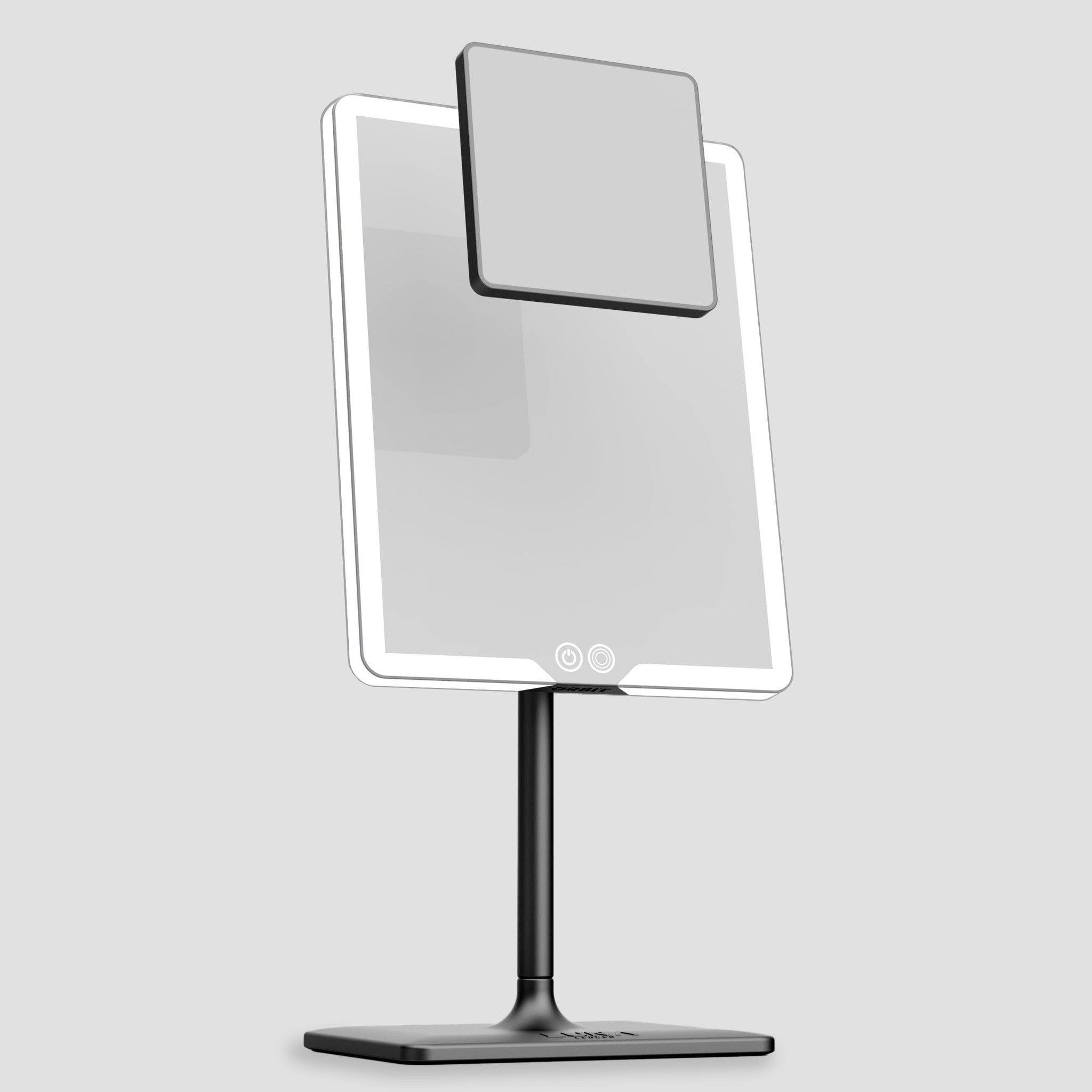
ORBIT A steady, adjustable ring light that makes “face-level light” easy at home. |
| Travel and hotel bathrooms | Portable, consistent light where overheads are harsh |
ECLIPSE Folds flat, then gives you predictable light when the room does not. |
| Touch-ups on the move | Quick shadow reduction plus close detail |
COMPACT 2.0 A fast “final check” light with 7X detail when you need it. |
A short video walkthrough (simple, practical setup)
If you want to go deeper on choosing warm vs cool vs natural modes (and why they can make you look subtly different), read: Best LED light settings for makeup: warm vs cool vs natural.
When your light is consistent, every tweak works faster
If you are tired of guessing under overhead bulbs, a dedicated face-level light setup makes these adjustments repeatable. ORBIT’s dimmable modes are designed for the “shadow reduction” effect you are aiming for, without cranking brightness.
FAQs
Does softer lighting actually make you look “younger”?
It can make you look more rested because it reduces harsh shadow edges and extreme contrast. That changes how features read, especially under the eyes and around the mouth. It is a lighting effect, not a skincare claim.
What lighting angle is least flattering?
A single strong ceiling light is the classic problem. Top-down light tends to deepen eye sockets and create stronger shadows under the nose and chin. A face-level light source is usually kinder.
Should I use warm or cool light to look better?
Warm light can feel cosy and forgiving, but it can also shift colour accuracy. For most people, a neutral to daylight-leaning light is best for “true” checks, then you can do a quick warm-light check for evening ambience.
Why do I look worse on Zoom than in the mirror?
Zoom exaggerates contrast and compresses colour. If your main light is above you or behind you, the camera will deepen shadows and flatten your face. Put a soft light at face level, slightly in front of you, and lower screen brightness a touch.
What is the fastest fix if I only have one lamp?
Turn off the ceiling light, put the lamp near your mirror at cheek height, and aim it at a pale wall to bounce softer light back onto your face.
Do I need a ring light?
Not necessarily. Ring lights can be great, but many people use them too bright and too close, which can look stark. A shaded lamp bounced off a wall can be surprisingly flattering.
How do I stop bathroom lighting making me look tired?
Reduce overhead dominance. Switch off ceiling downlights if possible and add a softer, face-level light source. If you cannot change the room, bring your “final check” to a better-lit area for 10 seconds.
What’s the difference between brightness and flattering lighting?
Brightness is how much light there is. Flattering lighting is how evenly that light falls across your face, how soft the edges of shadows are, and whether colour looks natural. You can be very bright and still unflattering.
Related Links
- How to create soft, flattering lighting for Zoom calls
- Daylight makeup: why indoor light changes your look
- Fix patchy foundation with better lighting
- 5 makeup mistakes people make under bad lighting
- How to prevent cakey makeup with better lighting


Leave a comment
This site is protected by hCaptcha and the hCaptcha Privacy Policy and Terms of Service apply.