
Last updated: 25 May 2026
How to Use 7x Zoom Without Overcorrecting Your Face
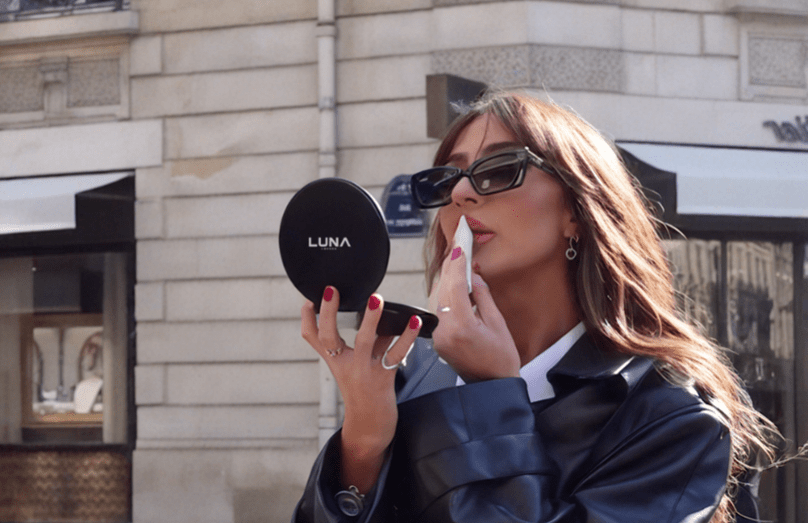
A 7x magnifying mirror is one of those beauty tools people either love or slightly fear. Used well, it makes small jobs easier: one brow hair, one lash corner, one contact lens, one beard edge. Used badly, it turns normal skin texture into a crisis and convinces you to fix things nobody else can see.
The more useful question is not “is 7x too strong?” It is: what job are you asking it to do? If you want a full-face makeup mirror, 7x should not be your main view. If you want a short close-up check, it can be exactly the right amount of help.
This matters more as near vision changes. The National Eye Institute describes presbyopia as a normal age-related change that usually appears after 45, making close-up tasks harder. Moorfields Eye Hospital also notes that by the mid-forties, even people who have never needed glasses often start needing help with reading vision. A good mirror cannot replace an eye exam, but it can make daily detail work less annoying.

In a hurry? The 7x mirror test
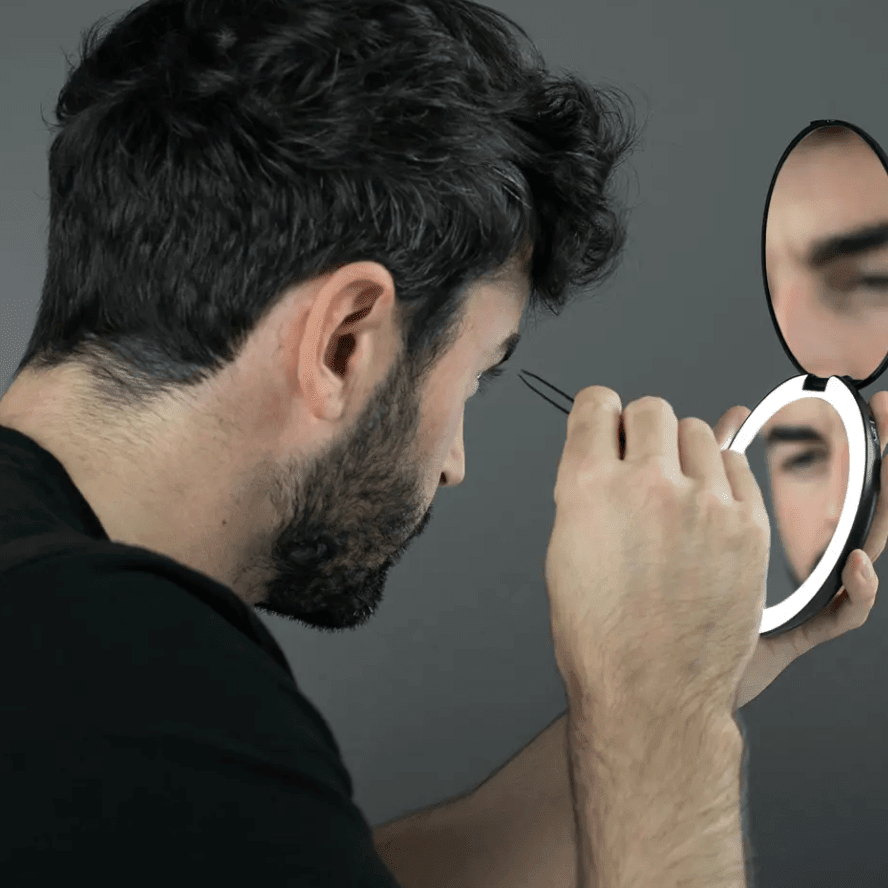
- Use 7x for: brows, lashes, eyeliner edges, contact lens insertion, stray facial hair, beard lines and small grooming checks.
- Avoid 7x for: judging foundation, powder, skin texture, blush placement or overall symmetry.
- Best method: decide in 1x, correct in 7x, finish in 1x.
- Best home setup: a large lit mirror with optional 7x, not a mirror that forces you into zoom all the time.
- Best travel setup: a compact lighted mirror with 1x and 7x, if you need close checks away from home.
What 7x magnification actually changes
Seven-times magnification makes a small area look much larger. That sounds obvious, but the practical effect is easy to underestimate. You gain detail, but lose context. The mirror shows you the lash line, one pore, one brow hair or one patch of concealer. It does not show whether the whole face still looks balanced.
That is why higher magnification is not automatically better. The Cleveland Clinic notes that presbyopia can bring symptoms such as needing more light, holding reading material farther away, headaches and eye strain. It also reports that about 1.8 billion people had presbyopia in 2015, with estimates rising to 2.1 billion by 2030. The takeaway is not “buy the strongest mirror”. It is “use better light and sensible magnification for close tasks”.
⚡ PRO INSIGHT: Treat 7x like a zoom lens, not a normal mirror. Use it to place, remove or align one detail, then step back into 1x before deciding whether anything else needs changing.
Who benefits most from a 7x magnifying mirror?
A 7x magnifying mirror is genuinely useful if your routine involves precision. That might mean applying false lashes, cleaning up brows, lining lips, placing eyeliner close to the lash root, inserting contact lenses, checking shaving lines or finding one missed hair before you leave the house.
It also helps people who have started noticing near-vision changes. If you are holding labels farther away, moving closer to the mirror or needing more light than you used to, magnification can make the routine feel calmer. That is especially true when the mirror also gives you controlled front-facing light.
For detailed beauty tasks, pair this article with our magnifying mirror for lashes tutorial and the best mirror for eyebrow tweezing. If you are comparing magnification strengths more broadly, the deeper guide on 5x vs 10x vs 15x magnifying mirrors will help you avoid buying too much zoom.
Confidence before you buy
A proper mirror for routines where small details matter
“My hubby likes to use it when shaving as he finds the light really helpful as our bathroom is quite dark.”
When 7x makes makeup worse
The biggest mistake is using 7x for the wrong decision. Foundation, concealer, powder and blush need distance. They are judged by the way they sit across the full face, not by one square centimetre of skin viewed close up.
If 7x makes you add more concealer under your eyes, remove three more brow hairs or start inspecting every pore, the setup is working against you. The American Academy of Dermatology recommends gentle cleansing, warm rather than hot water, and moisturising quickly after washing for dry skin. That advice matters here because magnification can make dryness look like a makeup failure, when the better fix may be skincare timing, light and restraint.
“Practitioners should not underestimate the emotional impact of these visual changes.”
— Clair Bulpin, locum optometrist and Johnson & Johnson faculty member, Association of Optometrists / Optometry Today (2024)
The 1x, light, 7x method
The best way to use a 7x magnifying mirror is boring, which is usually a good sign. Do not start in zoom. Start with the whole face, then use 7x for one job only.
- Start in 1x: check the overall shape, balance and placement before zooming in.
- Set the light: use even front-facing light, not overhead bathroom shadow.
- Switch to 7x for one task: lash corner, brow hair, lens placement, lip edge or beard line.
- Set a stop rule: 30 to 90 seconds per area is enough for most close checks.
- Return to 1x: this final realism check stops over-tweezing, over-blending and over-fixing.
⚡ PRO INSIGHT: If you can only see the “problem” in 7x, it may not be a problem. Correct what is still visible in 1x from normal distance, then leave the rest alone.
Home mirror or compact 7x?
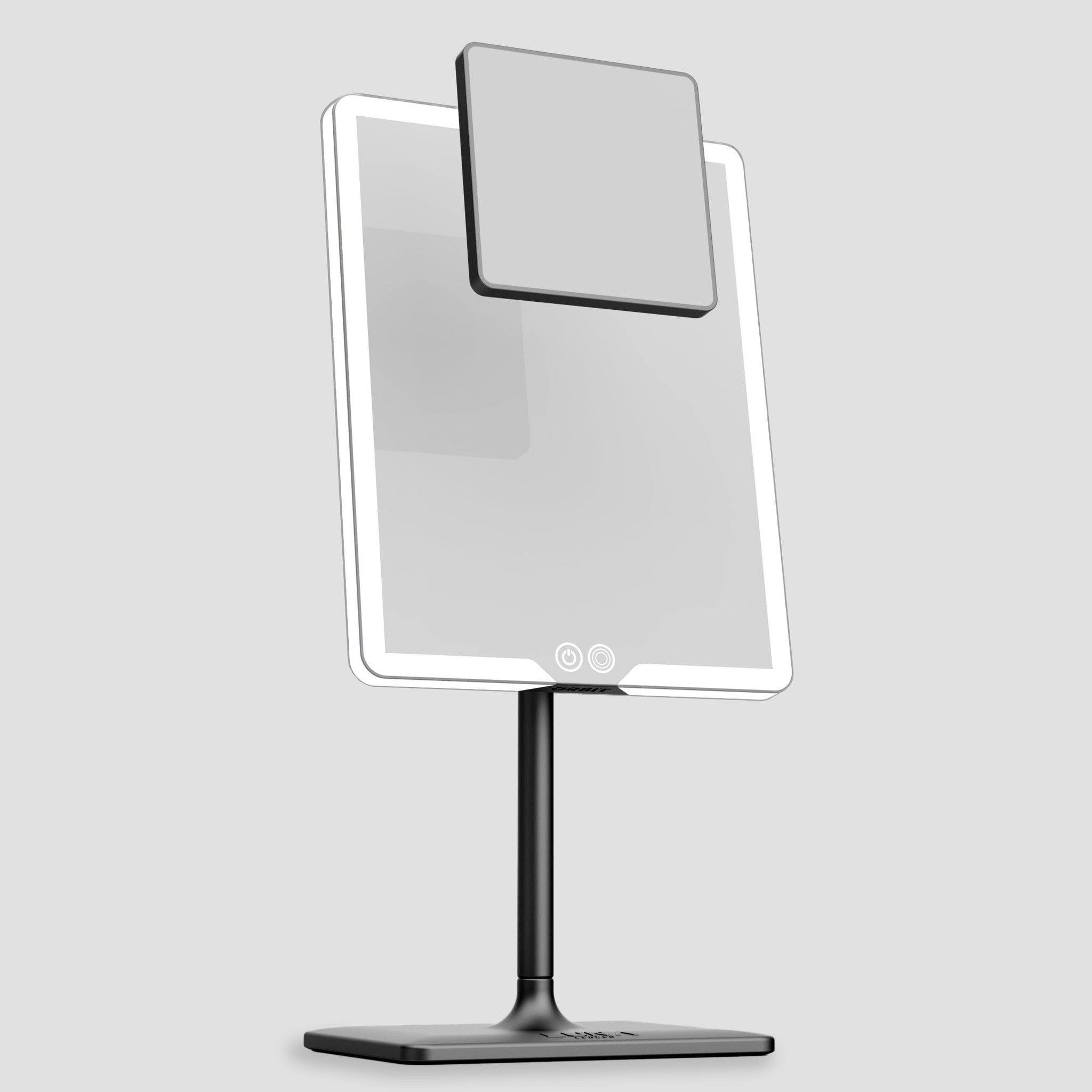
Where you use the mirror matters as much as the magnification number. At home, a large lit mirror is more forgiving because you can keep your full-face view and add 7x only when needed. That is why ORBIT is the stronger fit for daily routines: it has a large 11-inch mirror face, 3 LED brightness settings and a detachable 7x magnification add-on for precise work.
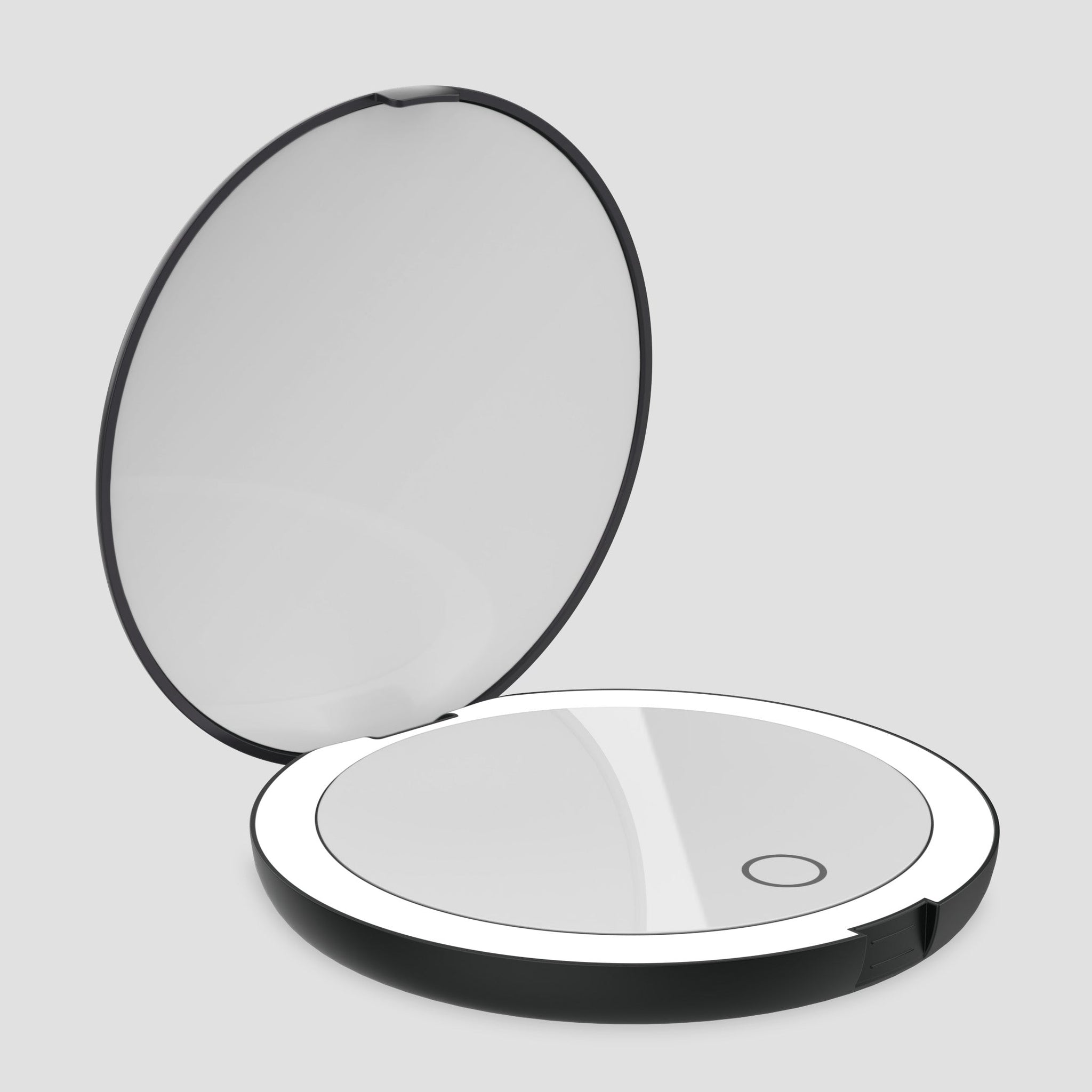
For travel or handbag checks, COMPACT 2.0 makes more sense when available because it combines 1x and 7x in a portable lighted mirror. The caveat is simple: portable mirrors are brilliant for quick checks, not long sessions where you need both hands free.

For detail without the spiral
Use 7x when you need it, not for the whole routine
ORBIT gives you the larger lit view first, then the detachable 7x magnification add-on for brows, lashes, beard edges and close checks. That makes it a calmer fit than doing everything in high magnification.
So, do you need a 7x magnifying mirror?
Yes, if you regularly do close-detail tasks and you are disciplined about stepping back. No, if you want one mirror for your entire face, or if magnification makes you pick, over-tweeze or overcorrect makeup that already looks fine at normal distance.
The winning setup is not “more zoom”. It is a mirror that lets you move between realistic view, good light and short precision. For most people, that means a 1x mirror first, 7x second, and a stop rule before the details take over.
Choose the mirror by the problem, not the magnification number
Quick tracked delivery available in:
 USA
USA
 UK
UK
 EU
EU
FAQs
Is 7x magnification too strong for everyday makeup?
It is too strong as your main view for most everyday makeup. Use 7x for short detail checks, then return to 1x before deciding whether your foundation, concealer or blush needs changing.
Why does my skin look worse in a 7x magnifying mirror?
Because 7x shows a small area in high detail. Normal texture, dryness and tiny hairs can look more obvious than they do at normal distance. If the issue disappears when you step back into 1x, it probably does not need fixing.
Is 7x good for eyebrows?
Yes, but only after you map the shape in 1x. Use 7x to remove individual hairs outside the plan, not to redesign the brow while zoomed in.
Is a 7x magnifying mirror useful for contact lenses?
It can be useful, especially when paired with even front-facing light. Magnification may help with close alignment, but stop if your eyes feel dry, sore or strained.
Should I choose ORBIT or COMPACT 2.0 for 7x?
Choose ORBIT if you want a stable home mirror with a detachable 7x magnification add-on. Choose COMPACT 2.0 if you want a portable 1x and 7x mirror for travel or handbag checks when available.
Related links
- 5x vs 10x vs 15x magnifying mirror: what works in real life
- Magnifying mirror for lashes tutorial
- Best mirror for eyebrow tweezing
- 7 signs you are using the wrong makeup mirror
- Travel skincare routine with a portable lighted mirror
- ORBIT Phantom Black


Leave a comment
This site is protected by hCaptcha and the hCaptcha Privacy Policy and Terms of Service apply.