


Your science-backed evening routine for calm skin and deeper sleep
When people say “my skin looks tired”, they are often describing circadian confusion as much as dehydration. Your skin follows a clock: barrier repair, micro-circulation, and renewal peak overnight, provided you send the right light and behavioural signals. The good news — a few small changes to screens, cleansing order, and lighting can improve both complexion and sleep quality within days.

Why screens and ceiling lights can derail your night
Light is the strongest zeitgeber, the signal that sets your body clock. Evening exposure to short-wavelength, blue-rich light can suppress melatonin and delay sleep onset. Brightness and distance matter too: lowering display brightness, warming colour temperature, and keeping devices further from the eyes reduces the melanopic load that reaches the retina. For lighting, think in terms of biologically active light rather than kelvin alone; evenings should be kept low and warm to help melatonin rise on time.
“If you’re able to see things really well, it’s probably too light.” — Dr Phyllis C. Zee.
What about blue light and your skin?
Beyond sleep, visible blue light can influence skin physiology. Reviews and lab studies associate high-dose blue-light exposure with oxidative stress and hyperpigmentation in some skin types. Timing and dose seem important, so a simple rule for sensitive skin is to reduce unnecessary blue-rich exposure close to bedtime, especially at high brightness.
The last 3 hours: a practical, melatonin-friendly flow
| Time window | Skin steps | Light & screens | Why it helps |
|---|---|---|---|
| -180 to -120 min | Remove makeup; gentle cleanse; moisturiser if dry. | Dim overheads; switch lamps to warm; set devices to warm mode. | Early cleansing prevents late-night over-washing; lower melanopic cues start the wind-down. |
| -120 to -60 min | Actives on clean skin (e.g., retinoid or exfoliant on alternate nights); seal with moisturiser. | Keep brightness low; avoid close-to-face scrolling. | Actives earlier avoid irritation from rushing just before bed; reduced light supports melatonin rise. |
| -60 to 0 min | Lip balm; hand cream; optional face mist. | Put devices away; keep lighting low and warm; prep room dark. | Consistent cues train circadian timing; darkness protects sleep onset and quality. |
Lighting cheat-sheet for better evenings
Think in layers. Use a soft, adjustable task light for skincare, then keep the room ambient low so pupils are not hit with unnecessary brightness.
| Scenario | Good | Better | Here’s Our Favourite |
|---|---|---|---|
| Precision skincare at the dresser | Table lamp with warm bulb | Low-glare mirror with adjustable brightness | ORBIT, stable, dimmable mirror with three light modes for comfortable evening use. |
| Shared bathrooms with harsh ceiling lights | Warm bulb swap with diffuser | Portable task light for face-level illumination | ECLIPSE, portable, three modes; set to warm and keep brightness low near bedtime. |
| Travel nights and hotel lighting | Use window light earlier; avoid down-lights late | Small travel mirror, warm setting | COMPACT 2.0, quick touch-ups with minimal glare in the last hour of the day. |
A gentler night routine you can actually keep
- Keep it early and easy: Do the main cleanse 2–3 hours before bed so you are not scrubbing under bright lights at 11pm.
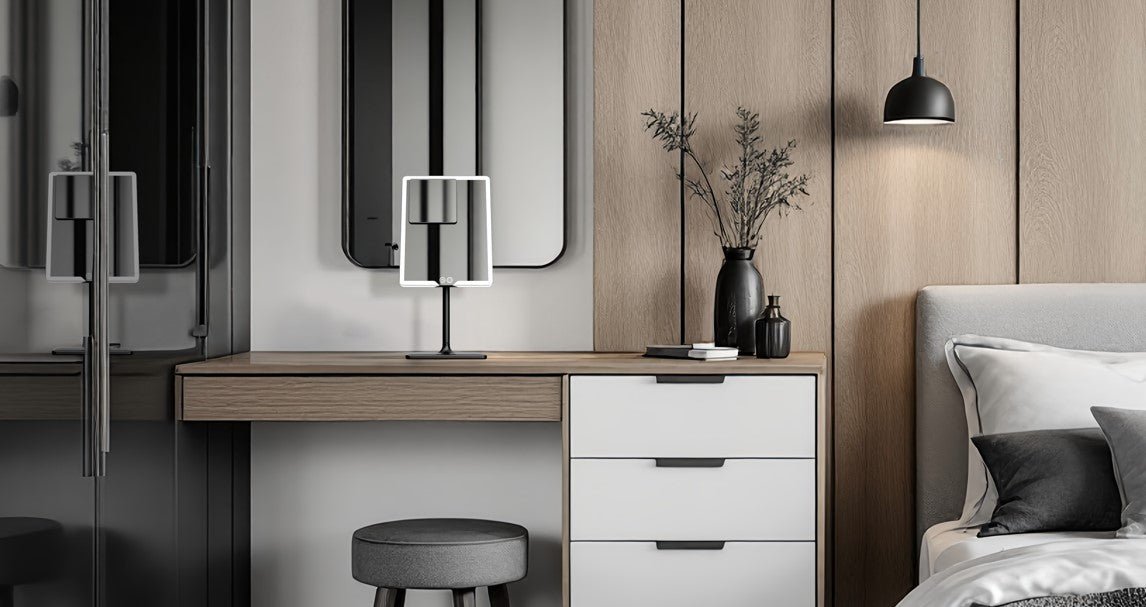
- Match light to the moment: Use a dimmable mirror for face tasks, then return the room to low ambient light.
- Make screen rules visible: Add a “Bed Mode” Focus that auto-dims, warms colour, and silences notifications after 9pm.
- Anchor mornings: Get outdoor light soon after waking to align tonight’s clock.
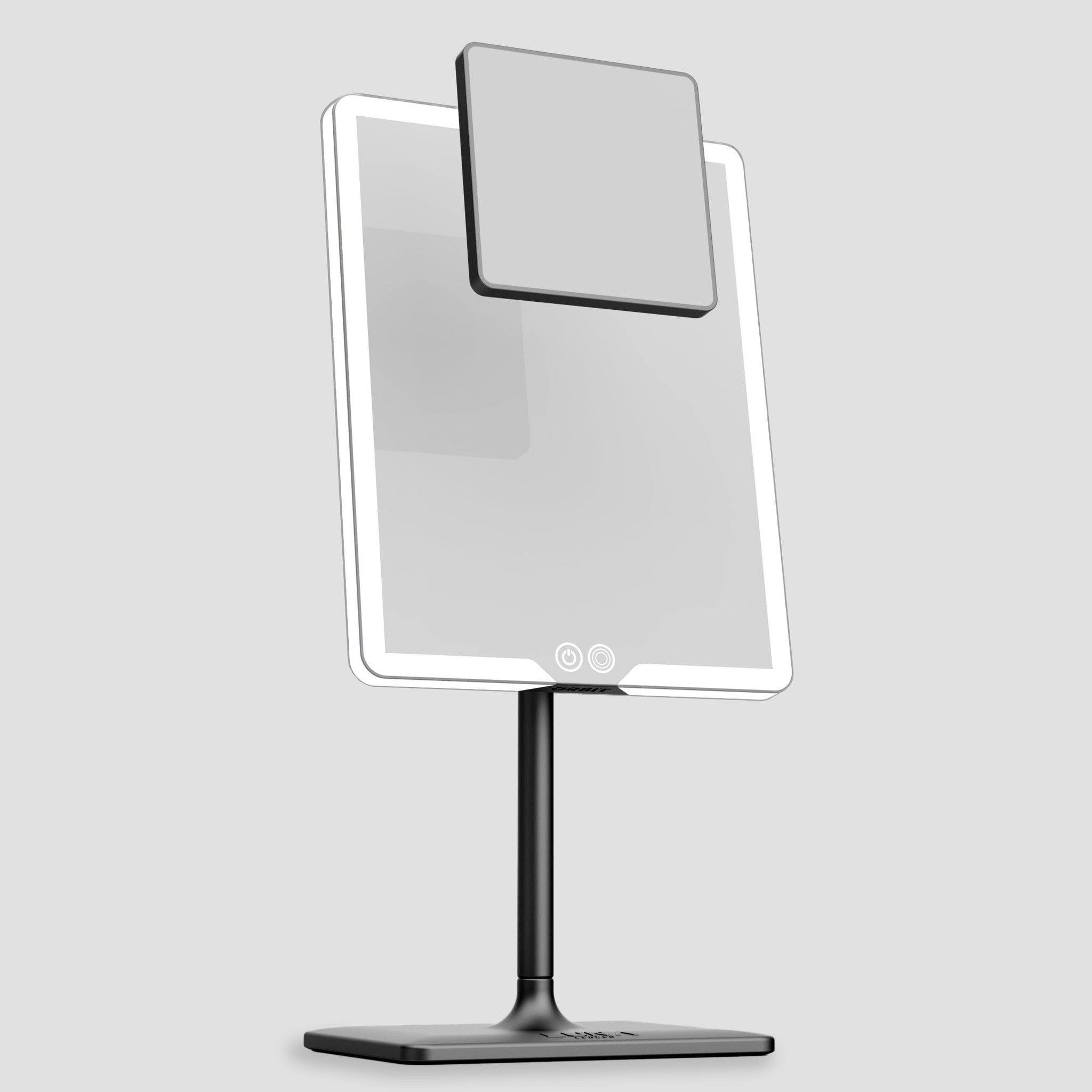
ORBIT’s three dimmable light modes make precision steps easy without flooding the room. Keep brightness low near bedtime and switch to a warmer tone to protect your wind-down.
FAQs
Does Night Shift or warm mode fix the problem?
It helps, but it is not the whole answer. Lowering brightness and increasing distance from the eyes make a bigger difference than colour shift alone.
How long before bed should I stop using screens?
As a rule of thumb, power down non-essential screens in the last hour. If you must use one, dim it fully, warm the colour, and sit back.
Can blue light age my skin?
Research links blue-light exposure to oxidative stress and hyperpigmentation in some skin types. Reducing bright, late exposure is a sensible precaution.
What lighting should I use for evening skincare?
Use low-glare, dimmable task lighting near the mirror, with the rest of the room kept low and warm. This limits biologically active light while letting you see fine detail.
Related links
- The Art of Eyebrow Care — LUNA Blog
- Men’s Grooming Mirrors — LUNA Guide
- Sleep Education: evening light tips — AASM
- Nighttime smartphone use and melatonin — Brain Communications (2024)

Leave a comment
This site is protected by hCaptcha and the hCaptcha Privacy Policy and Terms of Service apply.