

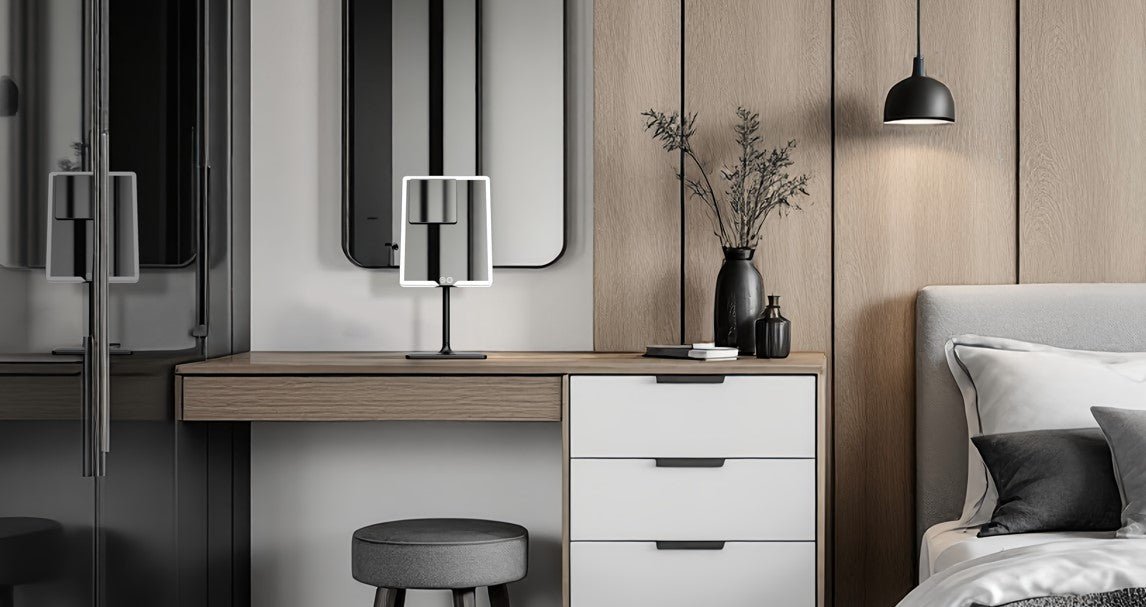
Makeup Mirrors with Lights vs Regular Mirrors: What Really Matters
Regular mirrors only reflect what the room gives them. If that light is overhead-only or the colour is off, your complexion can look dull, bronzer reads muddy, and detail work becomes guesswork. A good makeup mirror with lights puts the right light in the right place—at your face—so colours look true and textures are visible without harsh glare. For a deeper dive on common pitfalls, see our practical read on makeup mistakes under bad lighting.
Why lighting quality beats “bigger mirror” every time
Colour accuracy depends on the light source, not the glass. Industry guidance explains colour fidelity via CRI and newer TM-30 metrics. High-CRI LEDs reveal undertones more reliably, which is why beauty creators favour them. For technique examples where light makes the difference, skim our smokey eye tutorial and the patchy foundation fix.
The spec shortlist (what to look for)
- CRI (Colour Rendering Index): Aim for ≥90 so blush, bronzer and undertones look accurate. For a primer on CRI/TM-30, consult authoritative lighting resources.
- Colour Temperature (CCT): 2700–3000K flatters warmth for evening; 3500–4500K is a sweet spot for everyday accuracy; ~5000K mimics daylight for outdoor checks. Our seasonal lighting guide shows practical switches between warm and daylight.
- Lux at the face: Target roughly 500–1,000 lux at the face for grooming. What matters most is evenness (no harsh hotspots).
- Uniform, face-level illumination: Light that arrives from both sides (or a full perimeter) reduces shadows vs. overhead-only.
- Dimming & modes: Step through warm/neutral/daylight to simulate the environment you’ll be in.
- Magnification: 5×–10× for liner, brows and blending transitions; 1× for overall balance.
Lighted vs Regular: What Actually Changes
| Factor | Regular Mirror | Lighted Makeup Mirror | Why It Matters |
|---|---|---|---|
| Colour accuracy (CRI) | Depends on room bulbs; often unknown | High-CRI (≥90) LEDs available | Truer shade-matching for base/lips/cheeks |
| Shadow control | Overhead-only casts downward shadows | Even vertical/perimeter lighting at face level | Cleaner blending & texture visibility |
| Real-world modes | Single colour; no control | Warm/neutral/daylight presets with dimming | Match lighting to venue (office, daylight, evening) |
| Detail work | 1× only; limited visibility | 5×–10× magnification options | Precision for liner, brows and edges |

Choosing colour temperature (CCT) you can trust
For soft evening looks, 2700–3000K gives a warm, flattering glow. For everyday makeup and shade-matching, designers commonly land between 3500–4500K; for outdoor checks, ~5000K simulates daylight. Our travel lighting guide shows how to sanity-check looks in hotel rooms and on the go.
Buying checklist (and how LUNA’s mirrors map to each need)
| Spec | What “Good” Looks Like | Use Case | Here’s Our Favourite |
|---|---|---|---|
| CRI | ≥90 for colour-true makeup | All complexions; shade-matching | ORBIT — high-fidelity LEDs, 3 light modes |
| Colour Temperature | Warm (2700–3000K), Neutral (3500–4500K), Daylight (~5000K) | Evening looks; office; outdoor | ORBIT — quick-toggle modes |
| Brightness (Lux) | ≈500–1,000 lux at face; dimmable | From soft glow to precision work | ORBIT — bright, glare-controlled |
| Uniformity | Even perimeter or side lighting | Shadow-free blending | ECLIPSE — compact, even field |
| Portability | Rechargeable, lightweight | Gym, office, travel | COMPACT 2.0 — pocket-ready |
When a regular mirror can still work
If you’re near a big window at midday, natural light can be excellent—but it’s not always available or consistent. For bathrooms and evenings, a purpose-built lighted mirror (or sconces at face height) wins on repeatability and accuracy. For more context, see our cosmetic light mirrors buyer’s guide and compact travel mirror guide.
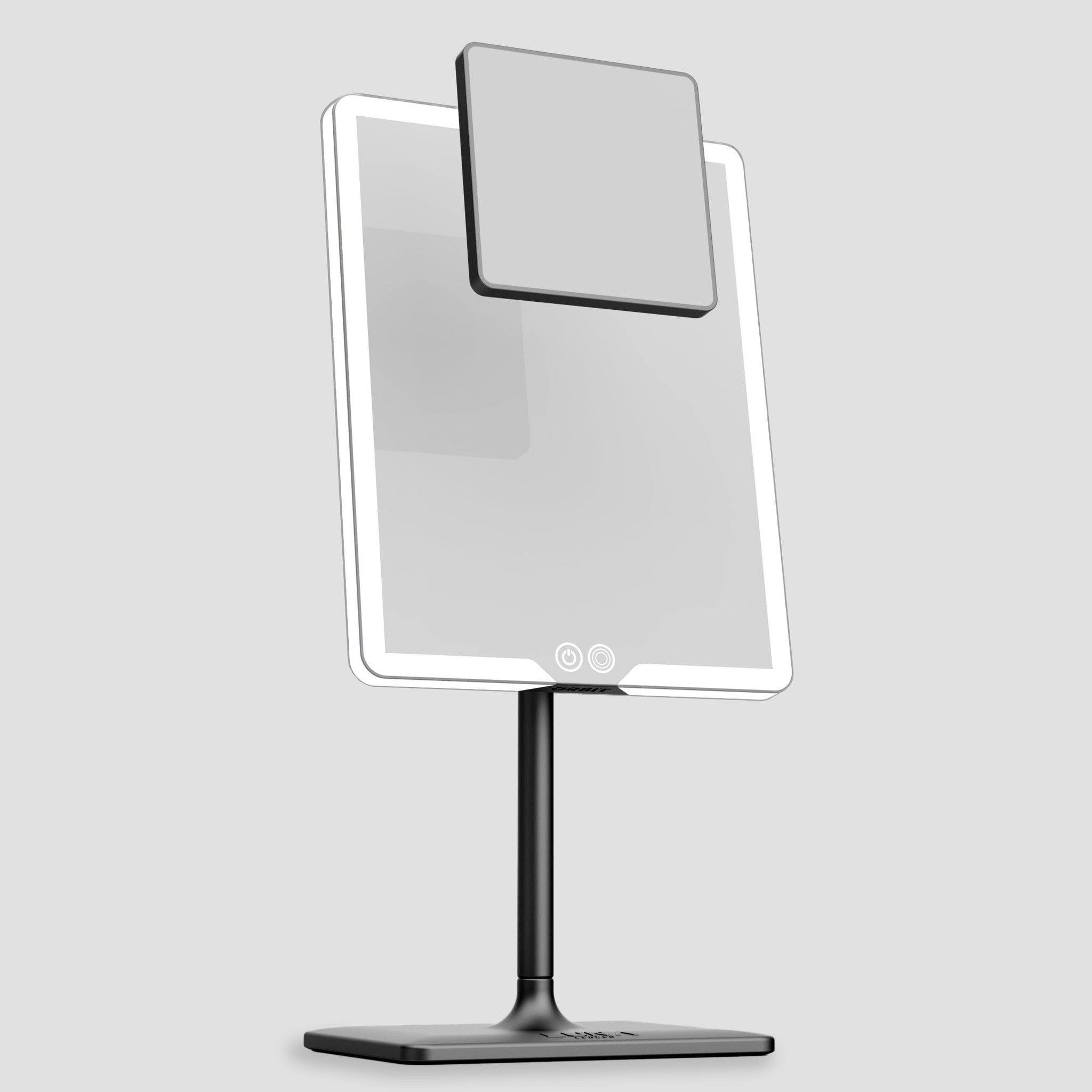
ORBIT pairs high-CRI LEDs, three lighting modes, and a 7× detachable face so skin looks true and detail is effortless—at home or on set. Available in Phantom Black, Soft Stone, Chalk Grey, Blush Rose, and Forest Green.
FAQs
What CRI should I choose for makeup?
Look for CRI ≥90 so colours are rendered accurately. High-quality LEDs easily achieve this today.
Which colour temperature is “best”?
No single best—use warm (2700–3000K) for evening, neutral (3500–4500K) for daily accuracy, and ~5000K for daylight simulation. A multi-mode mirror covers all three.
Why does overhead-only lighting look bad?
It casts top-down shadows that flatten features and hide texture. Side/perimeter lighting at face height evens illumination and reduces shadows.
How bright should a makeup mirror be?
About 500–1,000 lux at the face with smooth dimming and good uniformity is practical for grooming tasks.
What magnification is most useful?
5×–10× for precision tasks (liner, brows) plus 1× for overall balance.
Related links
- Fix Patchy Foundation with Better Lighting — LUNA Blog
- Halloween Makeup Looks: Avoid Lighting Surprises — LUNA Blog
- Smokey Eye: The Lighting-Proof Method — LUNA Blog
- DOE — LED Basics: CRI & TM-30
- ANSI E1.55 — Theatrical Makeup Mirror Lighting
- This Old House — Bathroom Lighting (side sconces)


Leave a comment
This site is protected by hCaptcha and the hCaptcha Privacy Policy and Terms of Service apply.