

Last updated: 15 March 2026
In a hurry? TL;DR:
- Ignore vague bulb words first. Check Kelvin and, where possible, CRI.
- Warm white is flattering, but it can hide over-application and shift foundation warmer.
- Natural or neutral white is usually the safest everyday baseline for undertones and blending.
- Cool, harsh overhead light, especially fluorescent-style bathroom light, can exaggerate texture and make you over-correct.
- The real fix is not just bulb colour. It is placement + consistency + colour accuracy.
- Do your main application in neutral/daylight-style light, then do a 30-second warm-light check before leaving.
Which bathroom light actually makes makeup look right in real life?

If your makeup looks fine in the bathroom and strange everywhere else, the problem is usually not your foundation, your skin, or your technique. It is the light. That sounds obvious, but most people still choose bulbs by what feels cosy rather than what shows undertone, texture, and blending truthfully.
There is also a naming problem. “Natural white” is not a scientific standard consumers can trust blindly. One brand’s natural white may sit near another brand’s cool white. The more useful checks are colour temperature, measured in Kelvin, and colour rendering quality, usually shown as CRI. If you want the companion reading after this, LUNA already has a live guide on warm vs cool vs natural light settings and another on why indoor light changes your look.
What warm, cool and natural white actually do to makeup

Bulb labels sound simple, but the lived effect is not. A warm bathroom can make your base look smoother than it really is. A stark cool fitting can make you think you need more bronzer, more concealer, and more powder than you actually do. A neutral or daylight-style setup tends to be the most honest starting point because it interferes less with undertone.
| Light label on the pack | Typical Kelvin range | What it usually does to makeup | Best use |
|---|---|---|---|
| Warm white | 2700K to 3000K | Adds warmth, softens shadows, can make foundation look more forgiving than it is | Final evening preview, ambience |
| Natural white / neutral white | Roughly 3500K to 4500K | Balanced, less yellow, usually the easiest everyday baseline | Everyday makeup application |
| Cool white | Often 4000K to 5000K, but labels vary | Can look crisp and useful for detail, but harsher versions can exaggerate dryness and texture | Short precision checks, not always ideal as the only light |
| Daylight | Around 5000K | Closer to outdoor colour balance, useful for shade matching | Base makeup, undertone checks, final truth test |
That range is not random. ENERGY STAR lamp terminology has long mapped 3000K as warm white, 3500K as neutral white, 4000/4100K as cool white, and 5000K as daylight. In other words, you should be sceptical of the marketing word and trust the actual number instead. The U.S. Department of Energy also notes that CRI 80 is a typical minimum for interior lighting, but that is a floor, not a beauty-specific target. For makeup, where small colour errors matter, 90+ is usually the more sensible aim.
⚡ PRO INSIGHT: If a bulb or mirror tells you the colour mode but says nothing about CRI, that is a clue. Kelvin tells you whether the light looks warm or cool. CRI tells you whether colours under that light are likely to look believable.

The real bathroom test: what happened under each light
To keep this practical, here is the test that matters more than theory. Apply your usual base, concealer and a light sweep of bronzer in one bathroom. Then check your face in two other conditions within two minutes: first by a window or in indirect daylight, then in the hallway or room where you will actually spend time. This exposes what the bathroom light is teaching you to over-correct.
| Test setting | How makeup looked at the mirror | How it looked outside the bathroom | Verdict |
|---|---|---|---|
| Warm-only bathroom | Soft, flattering, skin looked smoother and slightly warmer | Foundation often read too peachy or too bronzed, jawline mismatch showed up faster | Good final preview, weak main baseline |
| Cool fluorescent-style overhead light | Texture, redness and under-eyes looked harsher than usual | Easy to find you added too much concealer or powder trying to “fix” what the light exaggerated | Useful warning sign, poor only source |
| Neutral or daylight-style face-level light | Undertone, edges and blending looked clearer without dramatic colour cast | Most consistent result in hallway, car mirror and daylight | Best main setup for most people |
This is why makeup for fluorescent lighting can feel so frustrating. It is not just that the light is “ugly”. It is often top-down, contrasty and unforgiving, especially in older bathrooms, offices and public loos. That makes you chase problems that are partly created by the light itself. If this is a recurring issue, it is worth also reading these common makeup mistakes under bad lighting and how better lighting fixes patchy foundation.
“A single downlight or ceiling fixture casts strong shadows under the eyes, nose, and chin, making it unflattering and impractical for tasks like shaving or applying makeup.”
— Betty Kajajian, Design Associate at John Cullen Lighting, Livingetc (2025)
So what is the best colour light for makeup?
The honest answer is not one fixed word. It is a sequence.
Use neutral or daylight-style light for the main application
This is where you match foundation, blend concealer, check the jawline and decide whether you actually need more product. For most faces and most routines, that means a neutral-to-daylight zone around 4000K to 5000K, with good colour rendering and light hitting the face evenly.
Use warm light as a preview, not your judge
Warm light can be lovely for an evening look, but it is too flattering to be your only referee. It tends to soften problems and add warmth to the face, which can tempt you into a foundation or bronzer choice that only works in that room.
Use cooler light briefly for detail, not for the whole face
If you are doing liner, lashes or a tiny concealer correction, a slightly cooler mode can help you see edges. But staying there for the full routine can be a trap. Harsh cool light makes many people pile on product because every pore suddenly looks like an emergency.
A simple bathroom lighting setup that actually works
- Choose one honest baseline. Neutral or daylight-style light should be the mode you use most.
- Get light at face level. Side lighting or mirror-integrated front lighting is usually more useful than relying on one ceiling spot.
- Keep the room consistent. Mixed bulbs are a mess. A warm ceiling bulb and a cool mirror bulb can pull you in opposite directions.
- Check undertone before coverage. If the colour is right, you usually need less product than you think.
- Do a 30-second exit test. Before leaving, check in natural daylight or the nearest brighter neutral space. That catches most mistakes fast.
There is a reason lighting professionals increasingly point beyond CRI alone and toward fuller colour-rendition tools like TM-30. You do not need to become an engineer to do your makeup, but you should know this: not all “white” light shows skin the same way. If you are very particular about reds, blush, lip colour or facial redness, a higher-quality light source matters more than a trendy label on the box.
⚡ PRO INSIGHT: The fastest way to improve makeup accuracy is not buying brighter light. It is removing the lie. One face-level, high-quality neutral or daylight baseline usually beats a brighter but badly placed overhead bulb.
Common mistakes that make you think your makeup is the issue
Using only the “pretty” light: flattering in the moment, risky outside the bathroom.
Standing too close: when the light is poor, people lean in and start correcting tiny details that nobody else will ever see. That is how you end up over-powdered.
Trusting “natural white” without checking Kelvin: the wording is not consistent enough to carry the decision on its own.
Ignoring placement: a good bulb above your head can still create a bad result if it hollows the under-eyes and pushes shadow down the face.
Trying to fix fluorescent lighting with more makeup: in many cases, you need a better mirror light or a better angle, not more product. If this sounds familiar, LUNA’s guide on preventing cakey makeup with better lighting is worth the next click.
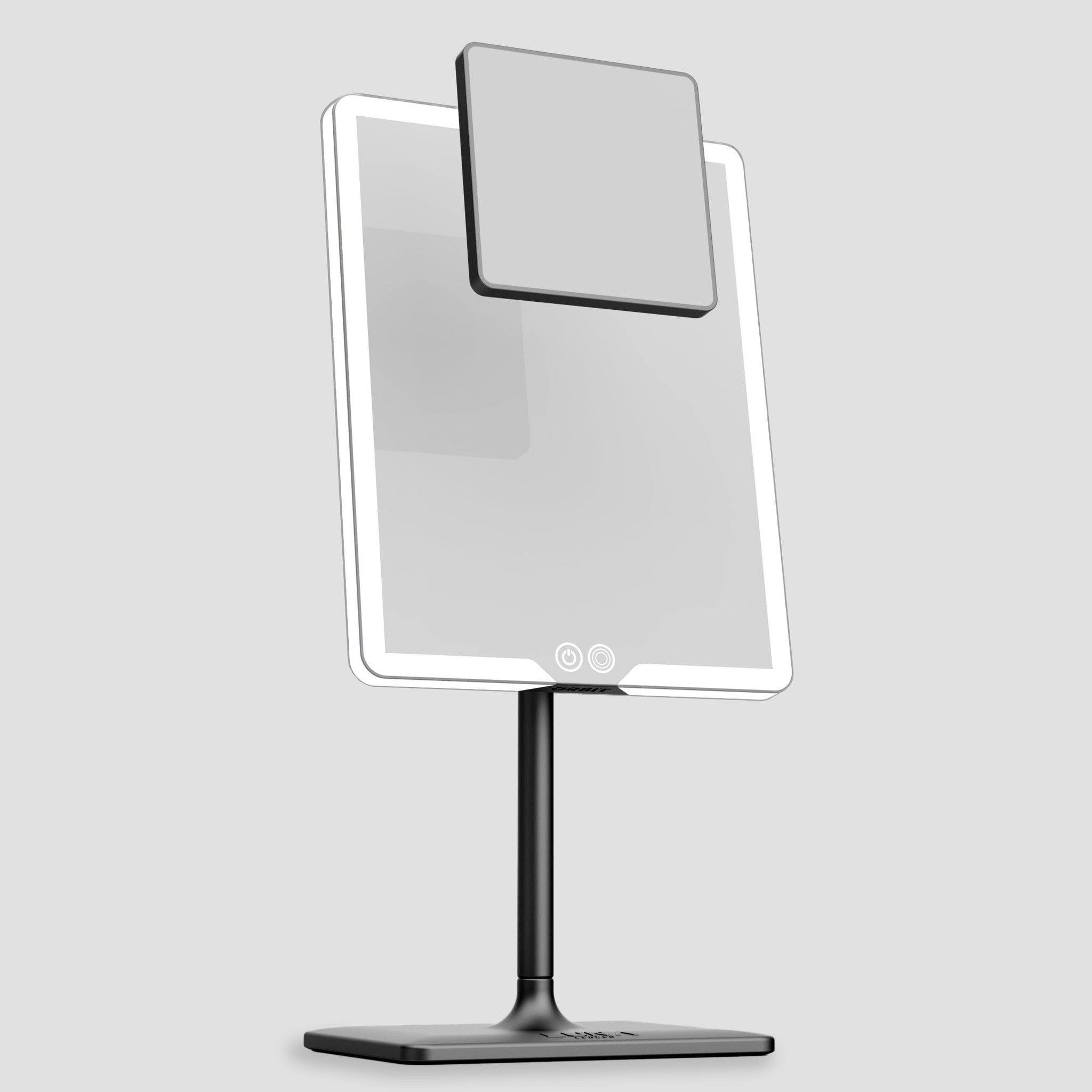
If you want one repeatable lighting baseline at home
The simplest fix is controllable front-facing light rather than guessing from whatever your bathroom already has. ORBIT keeps things practical with warm, neutral white and natural daylight modes, so you can apply in one honest setting and preview in another without changing rooms.
Explore ORBIT lighting modes →FAQs
Is warm or cool light better for makeup?
Neither extreme is ideal as your only light. Warm light is useful as a flattering final check, while a neutral-to-daylight setting is usually better for the main application because it interferes less with undertone.
What is the best colour light for makeup in a bathroom?
For most bathrooms, aim for a neutral or daylight-style setting around 4000K to 5000K, with light landing on the face from the front or sides rather than just from above.
Is natural white light good for makeup?
Usually yes, but check the actual Kelvin rating because “natural white” is not labelled consistently across brands. It often sits in the most useful everyday range, but not always.
Why does my makeup look worse under fluorescent lighting?
Fluorescent-style overhead lighting can be cool, flat and shadowy, especially in older fittings. That can exaggerate texture and make you over-correct with concealer, powder or bronzer.
Do I need CRI 90 for makeup?
It is a sensible target if you care about accurate undertones and colour matching. CRI 80 may be acceptable for general interior lighting, but makeup benefits from better colour fidelity where possible.
Should I do my makeup in daylight only?
Daylight is great for truth, but it changes constantly with time, weather and window direction. A good neutral or daylight-style artificial setup is more repeatable, then you can do a quick daylight sanity check.
What is the quickest way to test whether my bathroom light is misleading me?
Do your makeup as normal, then check it in indirect daylight and one other room within two minutes. If your base suddenly looks warmer, heavier, flatter or more textured, your bathroom light is the problem.
Related links
- Warm vs cool vs natural light: what the settings actually do
- Daylight makeup: why indoor light changes your look
- How to fix patchy foundation with better lighting
- Makeup mistakes under bad lighting, and how to spot them fast
- How to prevent cakey makeup with better lighting
- Browse the LUNA blog hub


Leave a comment
This site is protected by hCaptcha and the hCaptcha Privacy Policy and Terms of Service apply.