

Last updated: 3rd April 2026
In a hurry? TL;DR
- Match foundation in neutral or daylight-style light first, not warm yellow bathroom light.
- Check your jawline and neck together, because undertone errors hide on the face alone.
- Front-facing light beats overhead light for blending, concealer and symmetry.
- Do one 20-second second-light check before leaving, especially for flashback-prone areas.
- If makeup only looks good in one room, the room is probably lying to you.
| What goes wrong | What bad lighting makes you do | Fastest fix |
|---|---|---|
| Patchy foundation | Over-apply to “cover” shadows and dryness | Use front-facing neutral light and build coverage only where still visible |
| Wrong shade | Choose a base that looks fine indoors but turns orange, grey or flat outside | Test along the jawline, then cross-check in daylight or a second light mode |
| Flashback | Keep adding brightening products or too much powder under the eyes | Use less product, blend outward, and preview your finished look in a brighter secondary check |
How to stop bad lighting from wrecking your makeup before you leave the house
Most people blame the formula when makeup goes wrong. Fair enough, sometimes the product is the problem. But if your base looks smooth at home and strange in a lift mirror, office bathroom or phone photo, the more likely issue is the lighting. Even Marie Claire’s recent bad-lighting feature makes the same point: bad light shifts undertones, exaggerates texture and can make otherwise good makeup look wrong.
That matters for CTR and search intent too, because people searching this topic are not really looking for theory. They want the quick reason their foundation looks patchy, their concealer looks chalky, or their flashback gets worse the second a camera comes out. So here’s the practical version: seven mistakes, seven fixes, and one calmer way to check your makeup before you commit to more product.
⚡ PRO INSIGHT: Bright light is not automatically accurate light. A setup can feel “clear” while still distorting undertone, shadows or colour balance.
A 30-second truth test before you touch another product
Before the mistakes, do this once. Hold a white tissue or plain sheet near your cheek. If it looks yellow, greenish or oddly grey in your mirror, the light is already skewing your read. Then turn your head left and right. If one side of the face disappears into shadow, that setup is pushing you towards over-correcting.
This is also why a lot of foundation guides recommend checking the jawline in more than one light source. L’Oréal Paris’s 2025 foundation matching guide advises testing on the jawline and checking swatches indoors and in daylight, which is a simple rule that holds up surprisingly well.

1. Matching foundation under warm yellow light
Warm bathroom bulbs can make skin look softer and more forgiving. Nice for ambience, terrible for shade judgement. When the room leans golden, people often choose a base that is too warm, then only discover the problem when it turns orange or heavy outside.
Fix: Match foundation in neutral or daylight-style light first. Then preview warm light only at the end, once your base already disappears into the jawline. If you want a fuller breakdown of when to use each light mode, this companion piece on warm vs cool vs natural light for makeup is the most useful follow-on read.
2. Letting overhead light create fake “problems”
Overhead-only lighting is one of the worst offenders. It deepens under-eye shadows, changes how redness reads around the nose, and makes people add more concealer or powder than they actually need. The result is usually not better coverage. It is heavier coverage in the wrong places.
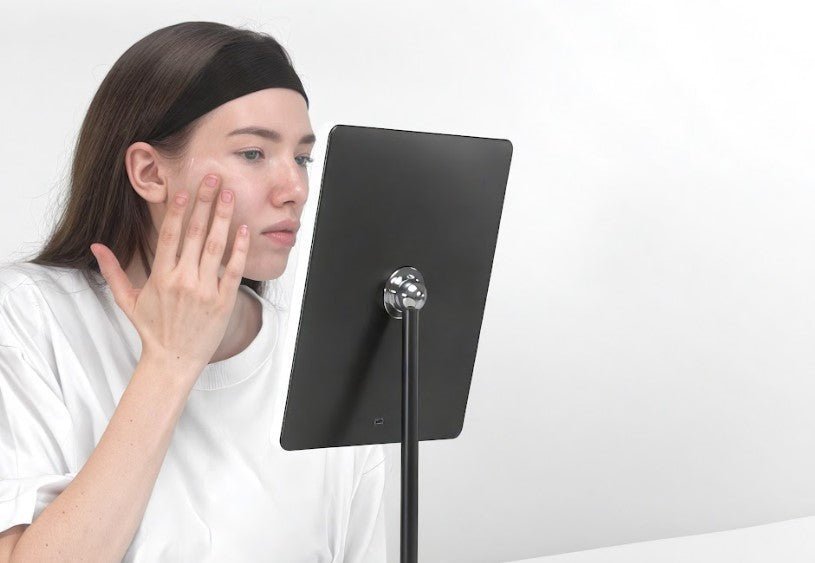
Fix: Bring light in front of the face at roughly eye level. Front-facing light gives you more even information across both cheeks, the chin and the jawline. If you are stuck with a harsh room, face the brightest source directly instead of half-turning into shadow.
| Lighting setup | What it tends to cause | What works better |
|---|---|---|
| Overhead bathroom light | Too much concealer, powder and texture panic | Front-facing light at eye level |
| One-sided window light | Uneven blending and cheek mismatch | Turn to face the window directly |
| Even front-facing light | Cleaner read on base, symmetry and texture | Best default for daily makeup |
⚡ PRO INSIGHT: If your concealer only looks “needed” under one harsh bulb, stop and move before adding more. False shadows create more cakiness than most people realise.
3. Confusing colour temperature with colour accuracy
People talk about warm and cool lighting as if that settles everything. It does not. Colour temperature tells you whether a light feels warmer or cooler, but not whether colours are being rendered faithfully. NIST’s overview of colour rendering explains why colour fidelity matters, and the CIE’s 2025 position statement is a good reminder that older CRI-style shorthand has limits, especially with LED lighting.
Fix: Treat neutral or daylight-style light as your baseline, but do not obsess over one metric in isolation. For makeup, what matters in real life is evenness, repeatability and the ability to compare your face with your neck and chest without odd colour shifts.
4. Using the mirror angle to flatter instead of tell the truth
This is a sneaky one. Tilt the mirror too far up and you deepen under-eye shadows. Tilt it too far down and you hide patchiness around the nose, mouth and chin. It feels helpful in the moment because the angle is kinder, but that kindness is exactly what causes bad corrections later.
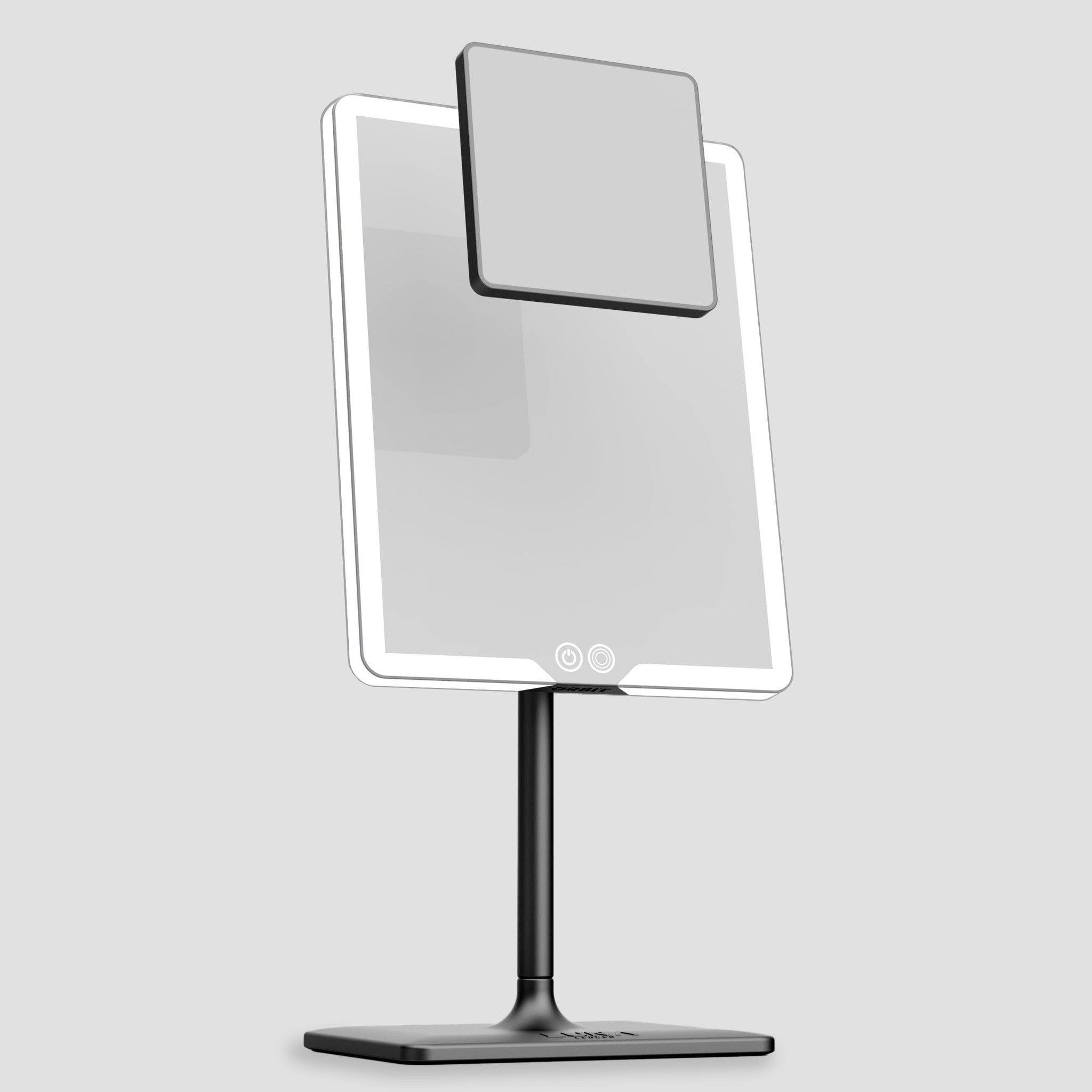
Fix: Keep your face square to the mirror, chin neutral, and adjust the light instead of gaming the angle. For detail work like liner or brows, magnification helps, but only after your overall base has already been checked honestly. That is where a setup like ORBIT or COMPACT 2.0 can help, because both give you a 7x detail option without forcing you to do the whole face in magnified distortion.
“Lighting makes a major difference in how your makeup appears.”
— Ashunta Sheriff, makeup artist, Allure
5. Adding more product when the real issue is shadow
Patchy foundation is often a feedback problem. If a room makes dryness or darkness look worse than it is, people respond by layering extra base, extra concealer or extra powder. Then they step into flatter light and wonder why the face suddenly looks thicker and more obvious.
Fix: Blend one thin layer in honest light, then build only where you can still see an issue when you face forward. If patchiness is your recurring problem, read Morning Sunlight vs LED Skin Checks and The Viral GRWM Lighting Secret next, because both help you separate actual skin texture from lighting-created panic.
6. Skipping the second-light check, then blaming flashback
Flashback is not caused by lighting alone, but bad lighting makes it easier to miss. If you finish your makeup under one forgiving room setup, you may not notice how bright the under-eye has become, how heavy the powder reads, or how disconnected the foundation looks from the neck once a stronger light source or camera hits it.
Fix: Before leaving, do a 20-second second-light check. Look for only three things: jawline match, under-eye heaviness, and whether the centre of the face looks brighter than the rest in a way that feels obvious. Nothing more. The goal is not to start again. It is to catch the one adjustment that matters.
7. Trusting the bathroom more than the real world
The final mistake is emotional, not technical. People trust the room they always use. But routine can make a bad setup feel normal. If your makeup regularly looks one way at home and another way everywhere else, stop defending the room. It is not helping.
Fix: Build a repeatable lighting routine: neutral or daylight-style for base, short detail checks for brows or liner, then one final preview before you leave. That is a much saner system than chasing perfection under a single bulb and hoping it translates.
When you want honest light, not guesswork
If bad bathroom lighting keeps pushing you into the wrong foundation, concealer or powder decisions, a front-facing setup is the faster fix. ORBIT gives you three light modes plus a magnetic 7x mini attachment, so you can check overall balance first and fine detail second.
Discover ORBIT lighting →FAQs
Why does my foundation look patchy in one room and smooth in another?
Because light changes what you think needs coverage. Harsh overhead light can exaggerate shadows and texture, which makes people add more product than necessary. In more even light, that extra product is what starts to look patchy.
What light is best for foundation matching?
Neutral or daylight-style light is usually the safest starting point because it gives a truer read on undertone and coverage. Warm light is better used at the end as a preview, not for the initial match.
How do I stop choosing the wrong foundation shade indoors?
Test on the jawline, compare face and neck together, and check the result in a second light source before you commit. One room is not enough if that room has warm or shadowy lighting.
Can bad lighting make flashback worse?
Yes, in the sense that it makes you more likely to miss heavy brightening or too much powder before a camera or stronger light source exposes it. A second-light check catches this more reliably than adding more blending.
Is CRI the only thing that matters for makeup lighting?
No. Colour fidelity matters, but so do light direction, evenness and repeatability. A technically “good” bulb can still be a poor makeup setup if it throws shadows or shifts colour across the face.
Should I do makeup in a bathroom at all?
You can, but do not assume a bathroom setup is accurate just because it is bright. If the light is overhead, mixed, or very warm, use a front-facing mirror or move to a setup that lets you see the full face more evenly.
Which LUNA mirror is most useful if bad lighting keeps sabotaging my routine?
For home use, ORBIT makes the most sense because it gives you stable front-facing lighting and a 7x mini attachment for precise detail checks. If you need portability with built-in 7x, COMPACT 2.0 is the better on-the-go option. ECLIPSE is portable and lighting-focused, but it does not have magnification.
Related links
- Warm vs Cool vs Natural Light for Makeup
- The Viral GRWM Lighting Secret
- Morning Sunlight vs LED Skin Checks
- Date Night Ready: Final Mirror Check
- ORBIT Soft Stone

Leave a comment
This site is protected by hCaptcha and the hCaptcha Privacy Policy and Terms of Service apply.