
Last updated: Sunday 24 May 2026

How to Build a Makeup Setup When There Is No Window
No window is annoying, but it is not the real villain. The real problem is uneven light. A yellow ceiling bulb, a shadowy bathroom mirror and a phone torch held too close will all make you apply more foundation, more concealer and more powder than you actually need.
That is where most “makeup no natural light” advice gets lazy. It says “use daylight” as if everyone has a bright north-facing window and a spare half hour. Plenty of people get ready in internal bathrooms, basement flats, hotel rooms, office toilets, rented bedrooms or winter mornings where daylight barely turns up. The better answer is to make your artificial light more honest.
If you want the deeper colour-temperature explanation, the LUNA guide to good lighting for makeup: warm, cool or natural white covers the science in more detail. Here, we are keeping it practical: what to put where, what to switch off, and how to stop your bathroom lying to you.
The quick answer: what beauty pros are trying to recreate
Beauty pros are not worshipping daylight because it is romantic. They like it because it is broad, even and colour-readable. When there is no window, your job is to recreate those qualities, not to blast your face with the brightest bulb in the room.
For makeup, the best artificial setup is usually:
- Front-facing light, so shadows do not sit under the eyes, nose and chin.
- A neutral or daylight-style mode for foundation, concealer and bronzer.
- A softer warm preview to check how makeup will look in evening or indoor light.
- A stable mirror angle, so you are not leaning over a sink or tilting your face into distortion.
- One final second-light check, because no single room tells the whole truth.
⚡ PRO INSIGHT: If your face is lit from above, your under-eyes and smile lines will look deeper than they are. Move the light in front of you before you change your concealer.
The no-window makeup setup that actually works
| Problem | Best fix | Why it works |
|---|---|---|
| No window in the room | Use a front-facing LED mirror with adjustable brightness | It replaces overhead shadows with even facial light |
| Bad bathroom lighting | Turn off the ceiling light if it is too yellow or too harsh | Stops mixed colour temperatures pulling your base warmer or cooler |
| Foundation looks fine indoors but wrong outside | Apply in neutral light, then check in a daylight-style mode | Reduces undertone mistakes before they become obvious later |
| Makeup looks cakey by the mirror | Lower brightness slightly and step back for a full-face check | Harsh close-up light can make texture look worse than real life |
A good no window makeup setup is less about “more light” and more about controlled light. The U.S. Department of Energy notes that quality LED lighting can offer comparable or better light quality than other lighting types, while residential ENERGY STAR rated LEDs use at least 75% less energy and last up to 25 times longer than incandescent lighting. For a daily routine, that matters because the right LED setup is practical enough to use every morning, not just on special occasions. See the Department of Energy LED lighting guidance.
Best for no-window rooms
ECLIPSE is the mirror to use when the room light is the problem
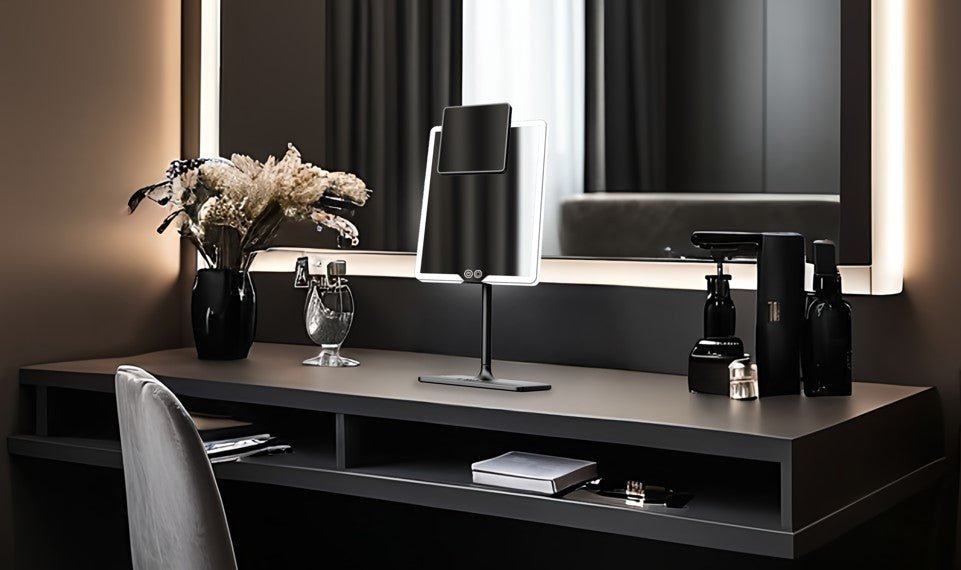
Slim, rechargeable and fold-flat, ECLIPSE gives you 3 LED brightness settings for bathrooms, bedrooms, hotel rooms and desk setups where natural light is not available.
Step 1: stop mixing three bad lights
Most bad bathroom lighting fixes start with adding something. Often, the smarter move is removing something. If your ceiling bulb is very yellow, very blue or directly overhead, switch it off while you apply base. Then use one controlled light source in front of your face.
Mixed lighting creates confusion. Your mirror light might be neutral, but if a warm ceiling bulb is hitting one side of the face and a cool hallway light is hitting the other, your foundation shade will never look stable. You will keep correcting a lighting problem with product.
Step 2: use neutral light for base, not warm light
Warm light can be flattering, but flattering is not the same as accurate. It softens redness, warms the skin and can make foundation look more forgiving than it is. That is lovely for a final evening preview. It is risky for shade matching.
Apply foundation, concealer and bronzer in a neutral or daylight-style setting first. Then use warm light as a secondary check. If you only use warm bathroom lighting, you are more likely to over-apply base, miss undertone errors or make bronzer too strong.
This is also why a room without a window can still beat a windowed room if the setup is controlled. A bright window behind you is not helpful. A portable lighted mirror in front of you usually is.
“The purpose of a foundation is to even out your complexion, enhance your skin tone, and minimize any skin concerns.”
— Alexx Mayo, celebrity makeup artist, Byrdie, updated 2026
That quote is a useful reminder. Foundation is not meant to fight your bathroom. If the light makes your face look uneven, do not immediately add more coverage. Fix the viewing conditions first.
Step 3: check colour accuracy, but do not obsess over jargon
Lighting specs can get nerdy fast: Kelvin, lux, CRI, TM-30, colour rendering, diffusion. Useful, yes. But if you are just trying to get ready for work, you do not need to become a lighting engineer.
The practical rule is this: use a mirror or light source that lets you compare how your makeup looks under more than one realistic condition. The Illuminating Engineering Society explains that CRI is a familiar average colour-fidelity metric, while TM-30 gives a more complete view of colour rendition across real-world samples. Read the IES position on colour rendition.
Translated for makeup: colour accuracy matters, but one number cannot rescue bad placement. A decent front-facing mirror setup will usually do more for your routine than a technically impressive bulb placed above your head.
Step 4: build a 7-minute routine for artificial light makeup
- Prep skin first. Moisturiser and SPF sit better when you give them a moment before base.
- Turn off the worst light. If the ceiling bulb is casting shadows, remove it from the equation.
- Set your mirror at face height. Looking down into a sink mirror changes how shadows fall.
- Use neutral light for base. Match foundation along the jawline and blend down slightly into the neck.
- Use a short brighter check for concealer. Only add more where discolouration remains visible.
- Switch warmer for the final preview. This shows whether blush, bronzer and powder still feel natural indoors.
- Do one second-light check. Hallway, phone camera, car mirror or office bathroom. Pick one and keep it consistent.
⚡ PRO INSIGHT: Keep the final check short. If you stare under harsh light for five minutes, you will start fixing normal skin texture that nobody else can see.
Which mirror setup fits your room?
| Room or routine | What matters most | Here’s Our Favourite |
|---|---|---|
| No-window bathroom or bedroom | Front-facing light, adjustable brightness, easy setup | ECLIPSE, because it folds flat and gives controlled light without needing a full vanity setup. |
| Daily home routine with detail checks | Bigger mirror face, stable stand, optional close-up precision | ORBIT, because it suits a permanent dressing-table setup and includes a 7x magnification add-on. |
| Bag, desk drawer or touch-ups outside the house | Pocketable size, quick mirror checks, precision on the go | COMPACT 2.0, because it is small enough to carry and has a 7x magnification mirror. |
If this sounds close to your problem, you may also like the LUNA article on makeup mistakes under bad lighting. It goes deeper on the specific errors: patchy foundation, orange base, too much powder and concealer that looks fine in one room but strange everywhere else.

For touch-ups away from the window
When the room lighting is not yours, bring your own
ECLIPSE folds flat, slips into a bag and gives you adjustable light when a bathroom, bedroom, hotel mirror or office setup is not doing you any favours.
The bad bathroom lighting fixes that are worth doing
First, stop placing your mirror under the bulb. Pull your setup forward, so the light lands on your face rather than behind your head. Second, clean the mirror. It sounds too basic, but product haze and toothpaste spray make texture look worse.
Third, stop using your phone torch as your main light. It is too small, too harsh and too close. It can be useful for a five-second smudge check, but not for foundation, bronzer or concealer.
Fourth, keep your products calmer. In poor light, heavy coverage looks tempting because it seems to “fix” shadows. In real life, that often turns into cakiness. Use a thin base, correct only where needed, then check again in a different light before adding more.
Finally, compare the room with a known reference. If your makeup always looks worse in one bathroom, the bathroom is probably the weak link. The LUNA article on why indoor light changes your makeup is useful if foundation looks fine inside but odd outside.
What to avoid when there is no natural light
Do not chase perfect brightness. Very bright light can be just as misleading as dim light if it is harsh and close.
Do not do your full base in warm yellow light. It flatters redness and warmth, so you may miss shade errors.
Do not judge makeup with your face inches from the mirror. Detail checks are useful. Full-face balance needs distance.
Do not buy a huge vanity setup just because one room is awkward. If you need portability, ECLIPSE or a compact travel makeup mirror may solve the real problem more cleanly.
Do not assume natural light is always better. Direct sun, backlight and grey winter light can all mislead you. Controlled artificial light is often more repeatable.
The final 60-second no-window check
Before you leave, do this once:
- Step back from the mirror and check the whole face.
- Look at the jawline and neck together.
- Smile once to check concealer and powder movement.
- Switch to a warmer light briefly to preview indoor settings.
- Take one quick phone-camera check, not twenty.
That is enough. If the makeup looks balanced across those checks, leave it alone. The goal is not flawless under a microscope. The goal is makeup that still looks like you when the lighting changes.
Portable light, cleaner makeup checks
ECLIPSE is the calmer fix for bad bathroom and no-window lighting
Choose it when you want a slim, fold-flat mirror with 3 LED brightness settings and no bulky setup. It is made for rooms where the existing light is not giving your makeup a fair chance.

Quick tracked delivery available in:
 USA
USA
 UK
UK
 EU
EU
FAQs
Can you do good makeup with no natural light?
Yes. The key is to use controlled front-facing artificial light rather than overhead bathroom light. Apply base in a neutral or daylight-style setting, then do a brief warmer check and a second-light check before leaving.
What is the best artificial light for makeup?
For most routines, neutral-to-daylight artificial light is best for foundation, concealer and blending because it makes undertone and texture easier to judge. Warm light is useful as a final preview, but it should not be your only application light.
How do I fix bad bathroom lighting for makeup?
Move the light in front of your face, reduce harsh overhead shadows, avoid mixing warm and cool bulbs, and use a mirror with adjustable brightness. If your bathroom has no window, a portable lighted mirror can make the setup more consistent.
Related links
- ECLIPSE travel makeup mirror with lights
- ORBIT vanity mirror with 7x magnification add-on
- COMPACT 2.0 lighted compact mirror
- Good lighting for makeup: warm, cool or natural white?
- Bad lighting ruins makeup fast: the easy fixes that help
- 10 small lighting adjustments that make you look younger instantly



Leave a comment
This site is protected by hCaptcha and the hCaptcha Privacy Policy and Terms of Service apply.