
Last updated: 12 February 2026
Minimalism in the Bathroom: One Mirror to Rule Them All
Minimalism is only useful if it makes real life easier. In a bathroom, that usually means fewer items on show, fewer things to wipe down, and fewer “where did I put that?” moments, while still getting better results from your routine.
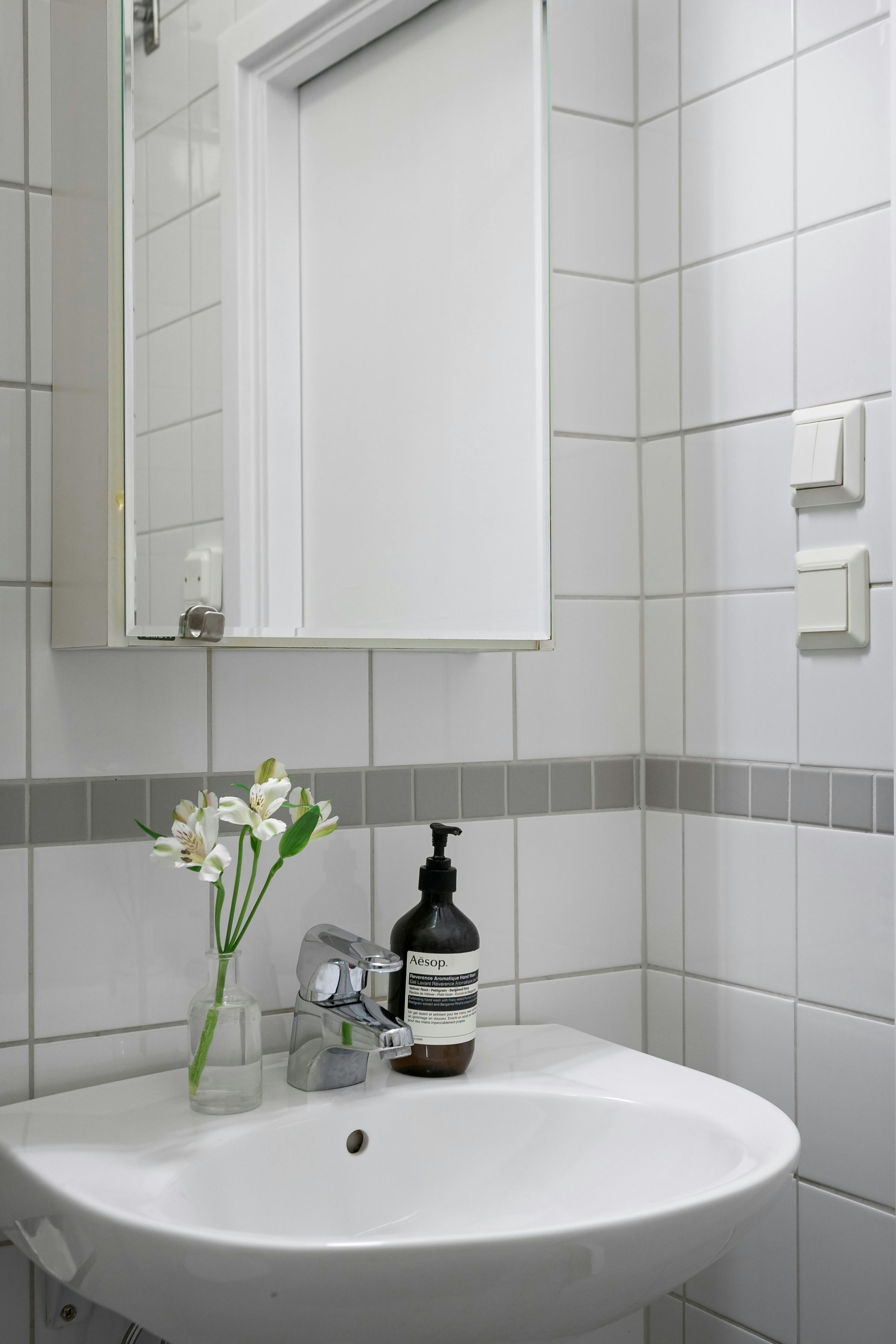
Summary: A minimalist bathroom works when the essentials are easy to reach, easy to clean, and genuinely multi-use. This guide shows how one vanity mirror with lights can replace extra gadgets, improve lighting for grooming and skincare, and keep your bathroom decor calm and intentional.
How to Build a Minimalist Bathroom Setup With One Vanity Mirror With Lights
In a hurry? TL;DR
- Choose one mirror that can handle daily grooming and skincare, so you can remove extra mirrors and tools.
- Prioritise consistent light (not “brightest possible”) so you stop fixing mistakes after you leave the bathroom.
- Place it where you’ll actually use it, then keep the surrounding surface almost empty for a calmer look.
- Protect it from steam with simple ventilation habits, because a minimalist bathroom still has to survive real humidity.
- Style with restraint: one tray, one soap, one hand towel, and the mirror becomes the “feature” by default.
The minimalist bathroom problem people ignore
Most “bathroom clutter” is not random. It’s a symptom of friction. When overhead lighting is harsh or patchy, people add a magnifying mirror. When the mirror is badly placed, people buy a handheld one. When the lighting changes between day and night, people start doing “final checks” in different rooms.
If you’ve ever caught a surprise in the hallway mirror after feeling confident in the bathroom, it’s usually a lighting consistency issue, not a skill issue. If you want the deeper explanation, our guide on LED mirror vs natural light breaks down why the same routine can look different under different light sources.
⚡ PRO INSIGHT: Minimalism fails when it becomes aesthetic-only. If an “essential” does not reduce friction in your routine, it’s decor pretending to be function.
What “one mirror to rule them all” actually means
In minimalist home terms, the goal is not to own one thing. The goal is to own fewer things because one thing does the job properly. In a bathroom, a vanity mirror with lights can earn its keep when it covers three everyday needs:
- Truthful lighting for skincare and grooming (so you stop compensating later).
- A comfortable viewing distance for detail work (shaving edges, brows, contact lens insertion).
- A stable “home” on the counter or shelf, so you do not move it around every time you clean.
If you want to sanity-check your current setup first, the most common mistakes show up in this piece on makeup mistakes under bad lighting. The same logic applies even if you wear little or no makeup, because lighting affects what you think your skin texture and tone are doing.
The one-mirror minimalism test
Here’s a simple way to decide whether one mirror can replace the extras. If your “main mirror” can’t cover at least two of these jobs, it’s usually why clutter creeps back in.
| What it replaces | Why that reduces clutter | What to check |
|---|---|---|
| Handheld mirror | No extra object to store, charge, or clean | Stable base, adjustable angle, easy repositioning |
| Harsh overhead “truth check” | You stop switching rooms to verify what you did | Consistent lighting you’ll use daily, not occasionally |
| Separate magnifier (for occasional detail) | Fewer specialist gadgets on the counter | Optional magnification for close work (used sparingly) |
| “Spare mirror” in a drawer | Less drawer chaos and fewer dead items | Mirror fits your actual routines (AM and PM) |
Lighting basics, without the nerd spiral
A minimalist bathroom is unforgiving in a good way. When the counter is clear, the lighting and the mirror do more of the “visual work.” That’s why it’s worth knowing one concept: colour rendering.
The Illuminating Engineering Society’s definition of colour rendering index (CRI) is the cleanest way to think about it: higher colour rendering helps colours appear more natural compared to a reference light source. In human terms, better colour rendering makes it easier to judge whether you’ve blended properly, shaved evenly, or applied skincare without missing patches.
If you prefer practical examples, our post on morning sunlight vs LED “skin checks” shows why the same face can look calmer or harsher depending on when, and where, you look.
⚡ PRO INSIGHT: “Bright” is not the goal. Consistency is. A light you can rely on every day beats a stronger light you only use occasionally.
Where to place one mirror so you actually use it
In a minimalist home, placement is half the battle. If your mirror lives where it’s inconvenient, you’ll add another one “temporarily,” and temporarily becomes permanent.
| Placement | Best for | Minimalist “add-on” | Avoid this |
|---|---|---|---|
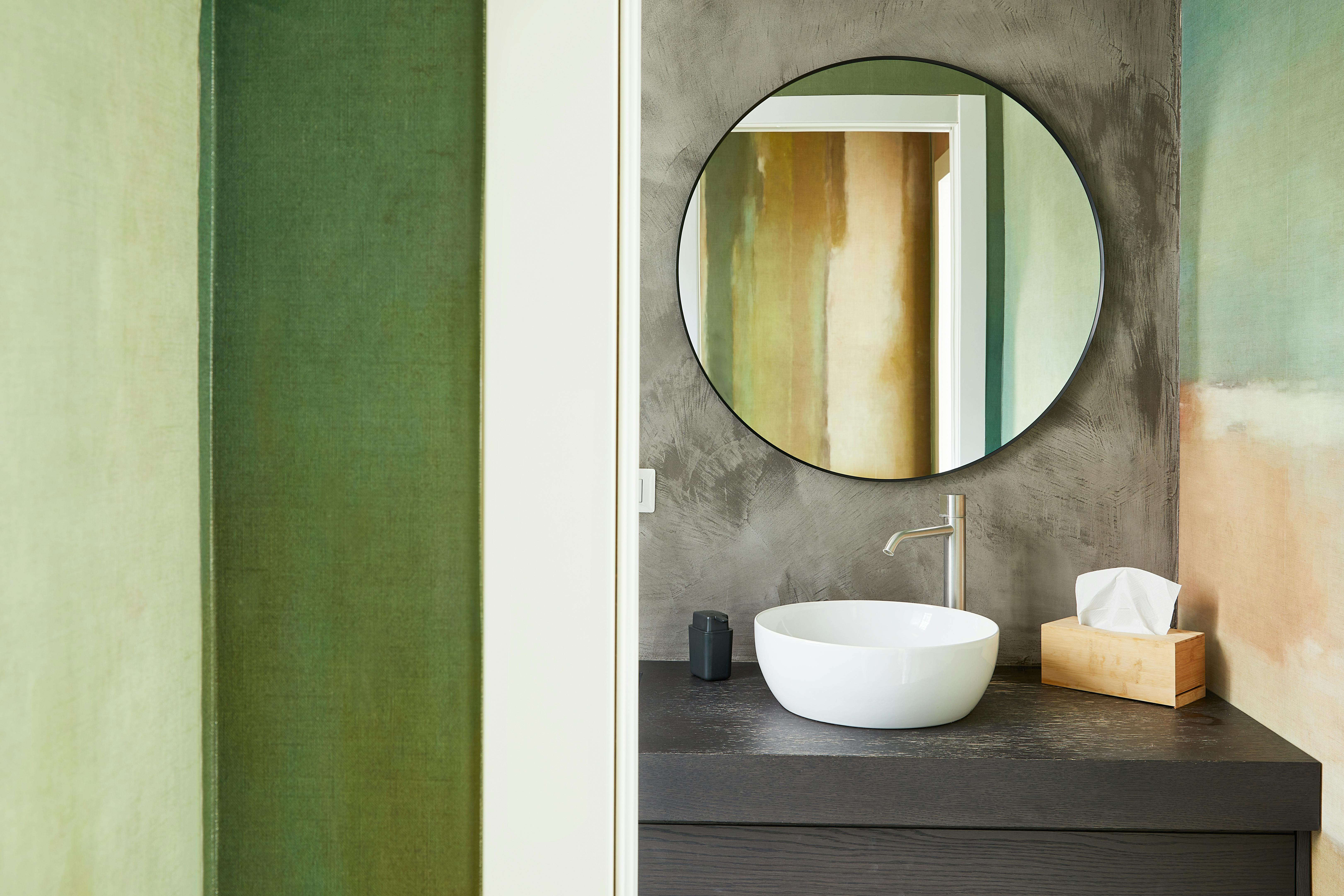
| Bathroom counter (corner) | Daily grooming, skincare, quick checks | One small tray for “daily three” items | Letting bottles surround the mirror base |
| Floating shelf near the basin | Keeping the counter almost empty | Hook or rail for towel, not more surfaces | Over-styling with multiple jars and candles |
| Near natural light (if possible) | A quick “daylight reality check” | Keep the path clear so it’s easy to move once | Dragging it room-to-room all day |
Humidity is the enemy of “pretty minimalism”
A bathroom is not a living room. Steam and condensation will test your minimalist bathroom decor quickly. If you want one setup that lasts, treat ventilation like part of the routine, not an optional “housekeeping task.”
Public health guidance is blunt: damp and mould can affect respiratory health, and some people are more sensitive than others. NHS inform summarises the health impacts and why moisture control matters in day-to-day living (damp and mould indoors). GOV.UK’s guidance on damp and mould also emphasises that moisture problems should be addressed at the cause, not just cleaned off the surface (health risks of damp and mould).
Even outside the UK context, the CDC’s overview is useful for the basics of mould and prevention (mould health and prevention). The minimalist takeaway is simple: if your bathroom stays damp, your “fewer, nicer things” plan turns into a cleaning burden.
Expert note
“Visual clutter is building right where you need clarity the most.”
Lavender Menakaya, quoted in Southern Living
(source)
A minimalist routine that keeps the counter clear
Minimalist home habits work when they are small enough to repeat. Here’s a simple “one mirror” rhythm that keeps the bathroom looking intentional without you constantly tidying.
Morning (2–4 minutes)
- Light on, quick scan: check under-eyes, redness, and any dry patches before you leave the house.
- One focused task: shave edges, tidy brows, or apply skincare, but avoid stacking tasks that cause clutter.
- Reset the surface: put everything back into one tray or one drawer section. Nothing stays loose.
Evening (3–6 minutes)
- Remove, cleanse, moisturise: keep the basics consistent, and store “extras” out of sight.
- One last check: if you tend to miss areas, use the same mirror and the same light. Don’t start hunting “better lighting” around the house.
- Dry down: after showers, a quick wipe and ventilation beats a deep clean later.
If you want a more technical shopping checklist, our vanity mirror buying guide covers sizes, light settings, and what actually matters day-to-day.
So where does ORBIT fit into a minimalist bathroom?
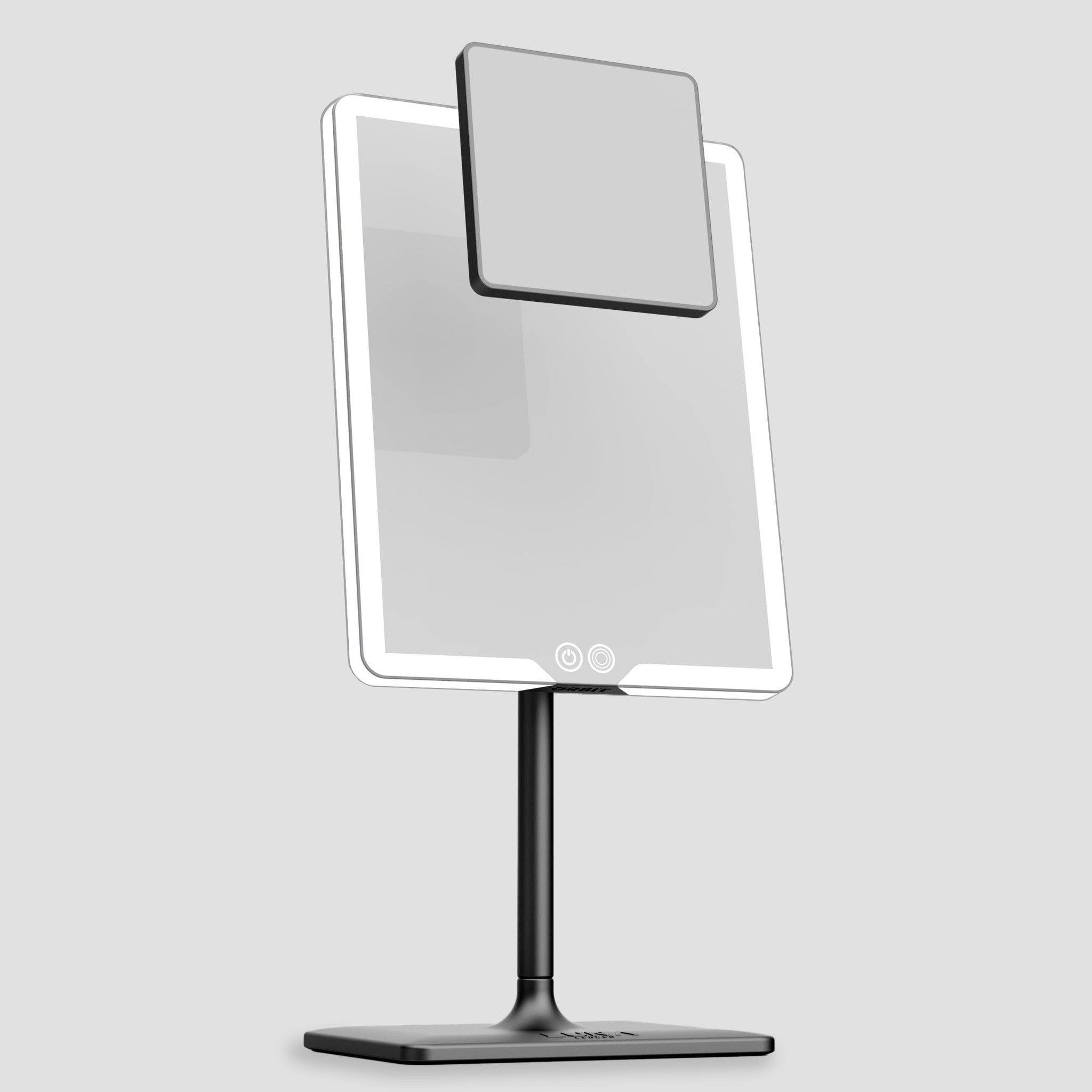
If your aim is one multi-use mirror that looks like it belongs in a calm bathroom, ORBIT tends to work best when you treat it like an “everyday tool,” not a special-occasion item. That means it gets a consistent home, a simple routine around it, and a finish that matches the room’s palette.
ORBIT is also one of the cleaner options when you need occasional close-up detail without adding a separate magnifying mirror to the counter, thanks to its optional 7x mini attachment. Use magnification for short tasks only, then go back to normal distance so you don’t over-correct tiny details.
| ORBIT option | Minimalist vibe | Pairs well with | Here’s Our Favourite |
|---|---|---|---|
| ORBIT Soft Stone | Warm-neutral, calm, “spa” minimalism | Stone, beige, warm metals, natural textures | Most versatile for a minimalist bathroom decor palette |
| ORBIT Chalk Grey | Cool-neutral, modern minimal | White tiles, chrome, cool greys | Great if your bathroom already leans crisp and bright |
| ORBIT Phantom Black | High contrast, architectural | Black hardware, industrial accents, strong lines | Pairs well with darker fittings (see how it looks in modern homes) |
| ORBIT Blush Rose | Soft warmth, understated character | Warm neutrals, muted pinks, brushed metals | Best if your “minimalism” is warm rather than stark |
Minimalism, but make it multi-user
The fastest way to break a minimalist bathroom is to pretend it’s a single-person space. If you share a bathroom, the rule is not “one of everything,” it’s “one home for the daily essentials.”
Practical example: one vanity mirror with lights can serve shaving, skincare, and detail checks for ageing eyes, but only if the area around it stays predictable. A simple tray for the shared basics (soap, hand cream, SPF) and one drawer section per person does more than buying more organisers.
If you’re buying for someone who is more grooming-focused, this men’s routine-friendly guide is a useful companion: men’s grooming with the right mirror lighting.
Minimalist bathroom decor: the “one feature” rule
A bathroom looks expensive and calm when it has one clear visual anchor and everything else supports it. In a minimalist bathroom, that anchor is often the mirror, because it sits at eye level and repeats light around the room.
- Keep one object on the counter on purpose, like a soap bottle you actually like, not five “nearly empty” ones.
- Repeat one material (stone, glass, matte ceramic) so the room feels intentional.
- Don’t over-style: minimalism looks best when it’s functional first.
A calmer bathroom starts with one reliable light source
If you’re aiming for minimalist bathroom decor, one dependable vanity mirror with lights can remove the need for extra mirrors, extra gadgets, and constant “second checking” under different lighting. ORBIT is designed to sit neatly in a routine and look intentional in the space.
FAQs
Do I really need a vanity mirror with lights in a minimalist bathroom?
Not always. But if your overhead lighting is inconsistent, a lit mirror can reduce the need for extra mirrors and “fixing mistakes later,” which is often what creates clutter in the first place.
Where should I put a lighted mirror in a small bathroom?
Put it where you’ll use it daily without moving it around. A corner of the counter or a sturdy shelf near the basin usually works best. If you keep relocating it, clutter tends to return.
What matters more: brightness or colour accuracy?
For daily grooming and skincare, colour accuracy and consistency tend to matter more than sheer brightness. Better colour rendering helps you judge tone and blending more reliably (see the IES definition of CRI).
Will steam and humidity damage my minimalist setup?
Humidity is what breaks “pretty minimalism.” The fix is routine ventilation and moisture control, not more organisers. NHS inform outlines why damp and mould are worth taking seriously in day-to-day living (damp and mould indoors).
How do I stop products building up on the counter again?
Give the daily essentials one defined home (one tray or one drawer section), and store everything else out of sight. If you can’t name where an item belongs, it will end up living on the counter.
Is magnification helpful or does it make people over-fix details?
Magnification is useful for short, specific tasks (shaving edges, contact lenses, detail grooming). The risk is using it as the default and over-correcting. Use it briefly, then step back to normal distance.
What should I read next if I’m choosing a mirror for both skincare and decor?
Start with the practical buying criteria in our vanity mirror buying guide, then compare light sources in LED mirror vs natural light.
Related links
- Vanity mirror buying guide: sizes, lights, and features
- LED mirror vs natural light: which is best for skincare routines?
- Makeup mistakes under bad lighting (and how to avoid them)
- Morning sunlight vs LED: better “skin checks”
- Damp and mould indoors (NHS inform)
- What CRI means (Illuminating Engineering Society)


Leave a comment
This site is protected by hCaptcha and the hCaptcha Privacy Policy and Terms of Service apply.