

Skincare lighting that stops wasted serums and missed SPF

Skincare feels forgiving. If you blend foundation badly, you know instantly. If you apply SPF too thinly or push retinol too close to the eye area, the mirror rarely tells you in the moment. That delay is why people keep switching products instead of fixing the real issue: visibility.
Most bathrooms are lit for ambience, not accuracy. Overhead bulbs create shadow pockets under the eyes, around the nose, and along the jaw. Warm bulbs can make redness look calmer than it is. Harsh side lighting can exaggerate dryness on one cheek and hide it on the other. In every case, your routine becomes guesswork.
Good skincare lighting does one thing well: it gives honest feedback while you apply. You see where serum is pooling, where retinol has been over-applied, and where sunscreen coverage is thin. Once you can see those problems, most “my skincare stopped working” moments get simpler fast.
⚡ PRO INSIGHT: Before upgrading products, upgrade the feedback loop. Better lighting often fixes “inconsistent results” without changing your routine.
What to look for in an LED mirror for skincare
Skincare lighting is not the same as mood lighting. The goal is not warmth, it is accuracy. These are the criteria that actually matter for serums, retinol and SPF.
| Feature | Why it matters for skincare | What it helps you spot |
|---|---|---|
| Neutral daylight (around 5000K) | Shows skin tone without warm distortion | Redness, irritation, uneven tone |
| High colour rendering (CRI) | Improves colour fidelity so you see skin as it is | Pigmentation, blotchiness, subtle redness |
| Even frontal illumination | Reduces shadow zones that hide missed coverage | Hairline, sides of nose, under-eye edges |
| Stable brightness with dimming | Lets you match morning and evening environments | Over-shiny areas vs genuinely hydrated skin |
If you want a deeper definition of CRI from a technical lighting body, the Illuminating Engineering Society defines CRI as a measure of colour shift compared with a reference light source of comparable colour temperature. Read the IES definition of CRI.
Why serums, retinol and SPF punish bad lighting
Serums: absorption is a visual cue
Serums are designed to absorb quickly. Under weak or overly warm light, skin can look matte even when it is already coated. That encourages unnecessary “one more pump” behaviour. Under accurate, even light, you can see sheen, tackiness, and pooling around the nostrils and smile lines before you keep layering.
Retinol: precision beats strength
Retinoids are powerful but not complicated. The most common problem is not that people pick the “wrong” product, it is that they apply it unevenly, too close to sensitive areas, or too often too quickly. Good lighting helps you apply deliberately, especially around the orbital bone, corners of the nose, and creases where irritation tends to show up first.
“Apply a small amount and avoid sensitive areas like the eyes and lips when you’re starting out.”
— Refinery29 UK dermatologist Q&A (Dec 2024)
SPF: missed zones are a lighting problem
People do not “forget” sunscreen, they apply too little and miss awkward geometry. The American Academy of Dermatology recommends using enough sunscreen and notes that for the face you should use at least about a teaspoon, roughly the amount covering the length of the index and middle fingers. See AAD guidance on how to apply sunscreen.
Accurate lighting matters because the classic miss zones are shadow zones: inner corners near the nose bridge, the hairline, temples, and the edges under the eye area. If your mirror setup makes SPF look “even” instantly, it is probably flattering you.
Common lighting mistakes that ruin skincare application
- Relying on ceiling light only: it creates under-eye and under-nose shadows, which hides missed SPF and uneven blending.
- Using a warm bulb as your “main” routine light: it can make redness look calmer and encourage overuse of actives.
- Standing too far back: glare and harsh brightness make people lean away, which reduces precision when applying retinol near sensitive borders.
- Confusing brightness with accuracy: high brightness with low colour quality can still hide tone shifts and irritation.
⚡ PRO INSIGHT: The best skincare mirror setup is the one that shows problems early, not the one that makes skin look smoother.
So, what’s the best LED mirror for applying skincare?

For most routines, the best choice is a stable, high-visibility LED mirror that gives a large viewing area and even light. That combination is what helps with consistent serum application, controlled retinol placement, and thorough SPF coverage.
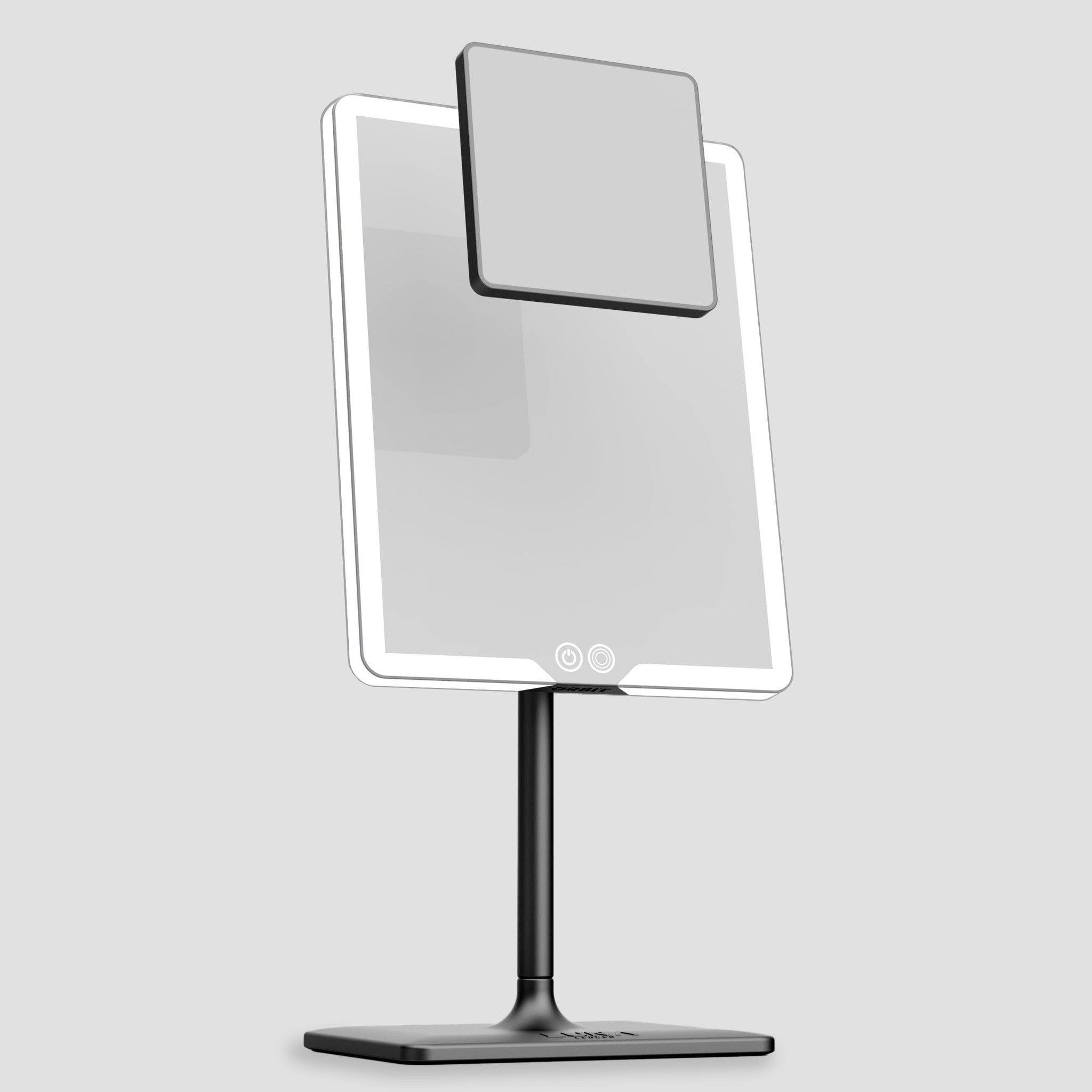
ORBIT is the strongest fit for a daily home routine because it gives a larger working area and more stable positioning than travel-first mirrors. It is especially helpful if you are applying skincare at a dressing table corner or bathroom shelf where overhead lighting is doing you no favours.
Quick comparison: ORBIT vs ECLIPSE vs COMPACT 2.0
| Use case | Best pick | Why | Here’s Our Favourite |
|---|---|---|---|
| Full AM and PM skincare routine | Larger, stable mirror | More even coverage checks, less shadow guessing | ORBIT for consistent, full-face visibility |
| Travel routines and hotel bathrooms | Portable, slim option | Reliable light when room lighting is unpredictable | ECLIPSE for compact clarity on the go |
| SPF top-ups and quick checks | Pocket-friendly mirror | Great for touch-ups, not ideal as a main station | COMPACT 2.0 for handbag and travel top-ups |
If you are specifically building a routine for mature skin visibility, you may also want to read our related guide on midlife skincare routines with LED clarity, which goes deeper on what changes after 45 and how to adapt without adding ten extra steps.
A practical “apply it correctly” routine under accurate lighting
This is the simplest way to use your LED mirror as a routine tool, not a décor item. The goal is consistent placement and consistent coverage, especially with retinol and SPF.
AM routine: serum + moisturiser + SPF
- Serum: apply, then pause 20 seconds and check for pooling around the nostrils and smile lines.
- Moisturiser: spread evenly, then tilt slightly and look for dry patches that catch light on the cheeks.
- SPF: apply enough product, then check the hairline, temples, sides of nose, and the edges under the eyes where shadow hides thin coverage.
PM routine: cleanse + retinol + moisturiser
- Cleanse: use even lighting to spot leftover product around the jaw and hairline.
- Retinol: apply a small amount and keep a clear border away from the eye area and corners of the mouth, then check symmetry side to side.
- Moisturiser: apply evenly and look for flaking zones that appear as texture under accurate light.
The gift angle: why this is an unusually “safe” skincare gift

If you are buying for someone else, skincare products are risky because they depend on skin type, fragrance tolerance, and active ingredient history. A lighting upgrade is different. It improves the routine they already have without forcing a product change.
This is one reason LED mirrors convert well as gifts for the 45–64 audience. They are practical, premium, and daily-use, with a clear “I get why this helps” payoff. If you want more gifting context, our roundup of best LED mirrors for Christmas 2025 also compares which mirror suits which lifestyle.
A calmer routine starts with clearer light
If your goal is more even serum use, gentler retinol application and fewer missed SPF zones, ORBIT gives you a stable, accurate view that makes small daily habits easier to keep.
Explore ORBIT finishes →FAQs
What LED colour is best for applying skincare?
Neutral daylight, roughly 5000K, is the most reliable for judging redness, texture and evenness. Warm light can make irritation look calmer than it is.
Does CRI actually matter for skincare?
Yes. CRI is about colour fidelity. Higher CRI makes it easier to see subtle tone shifts that can indicate irritation or uneven application. For a formal definition, see the Illuminating Engineering Society CRI entry.
How much sunscreen should I use on my face?
The American Academy of Dermatology recommends using enough sunscreen, and notes that when applying sunscreen to your face you should use at least about a teaspoon, roughly the amount that covers the length of your index and middle fingers. Read AAD sunscreen application guidance.
Is a magnifying mirror better for retinol?
Not necessarily. Magnification can encourage over-fussing and applying too close to sensitive areas. Even, accurate light usually matters more than magnification for safe retinol placement.
Do I need a different mirror for travel?
If you travel frequently, a portable option can be helpful because hotel lighting is unpredictable. For main routines at home, a stable mirror with a larger viewing area is usually more comfortable and consistent.
Is an LED mirror a good gift if I don’t know their skincare products?
Yes. A lighting upgrade improves the routine they already have without guessing their skin type or active ingredient preferences, which makes it a safer gift than serums or retinoids.
Related Links
- Midlife Skincare Routine for 45+: LED Lighting for Clarity
- How to Prevent Cakey Makeup (Lighting Tips Included)
- Best LED Mirrors for Christmas 2025
- How to Shave Cleanly with the Right Grooming Mirror
- American Academy of Dermatology: How to apply sunscreen



Leave a comment
This site is protected by hCaptcha and the hCaptcha Privacy Policy and Terms of Service apply.