

Last updated: Monday 5 October 2026
Most people searching "5x vs 10x vs 15x" assume the strongest mirror must be the best one. It rarely is. Magnification changes more than size: it changes how close you have to stand, how much of your face you can see and how much every tiny movement is exaggerated. This guide compares each strength by task, so you can buy the lowest magnification that actually solves your problem.
If you are choosing for yourself or a parent whose close-up eyesight is changing, read this alongside our guide to the best magnifying mirror for elderly eyes, which covers light, steadiness and setup in more depth.
In a hurry? Which magnification to choose
- 5x: comfortable everyday detail for mascara, concealer edges and light brow tidying.
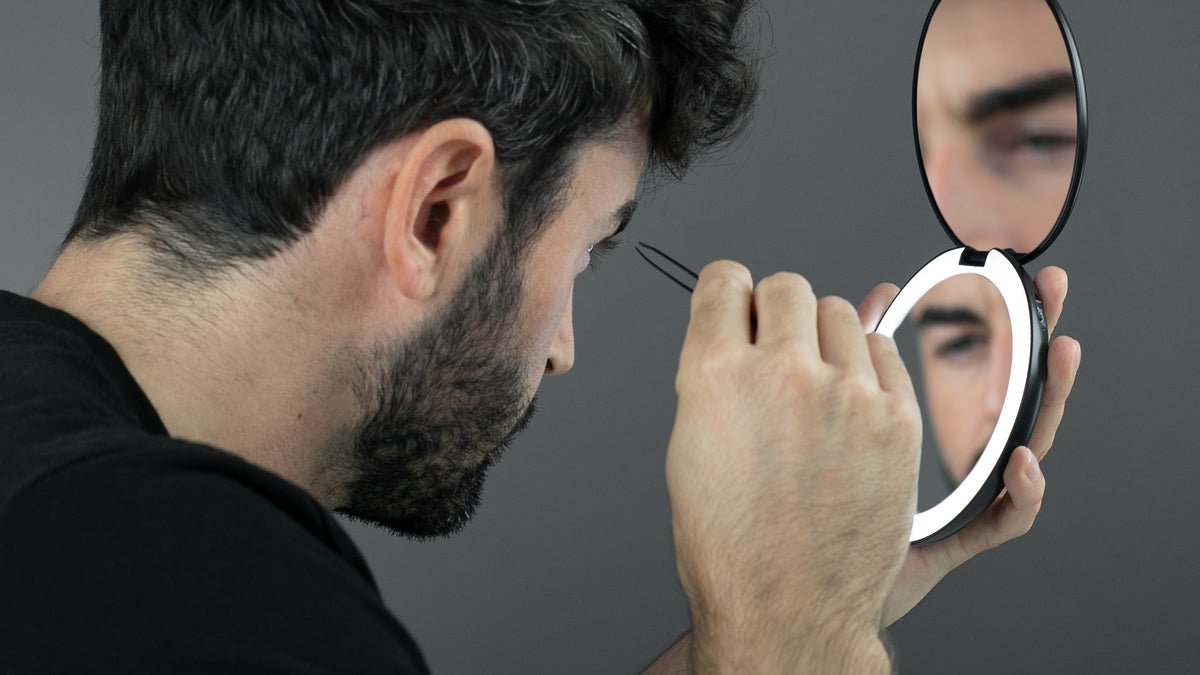
- 7x: the practical precision zone for brows, lash roots, contact lenses, beard edges and stray hairs. ORBIT (£119.99) pairs an 11-inch lit mirror with a detachable 7x mini mirror; COMPACT 2.0 (£39.99) gives you 1x and 7x in your bag.
- 10x: fine for one hair or one lash edge at a time. Too intense for a full routine.
- 15x: specialist territory, such as a splinter or an ingrown hair. It exaggerates texture and encourages over-correction.
- Before any of them: fix your light. Shadows look bigger under magnification, not smaller.
5x vs 7x vs 10x vs 15x: the quick decision table
| Magnification | Best for | What goes wrong | Best LUNA London fit |
|---|---|---|---|
| 5x | Daily eyeliner, mascara checks, concealer edges, light brow shaping | Not quite enough for one tiny area if your near vision is changing | Use as your comfort benchmark before going stronger |
| 7x | Brows, lash roots, contact lenses, beard edges, stray hairs, lip lines | Too close to judge your whole face, foundation or blush | ORBIT at home, COMPACT 2.0 on the go |
| 10x | Short, controlled precision: one brow hair, one lash edge, one beard corner | Leaning in, losing the sharp spot, over-tweezing | A specialist second mirror, not your main view |
| 15x | Single-task checks such as a splinter or ingrown hair | Every pore looks like a problem, so you over-correct | Usually too strong for everyday makeup and grooming |
How magnification really works

A magnifying mirror is curved. The stronger the curve, the bigger the reflection, but the smaller the area that stays sharp and the closer you need to be to it. That is why a 15x mirror feels like looking through a keyhole, and why many people buy one, try it twice and go back to squinting at the bathroom cabinet.
If you have ever thought "why do I have to get so close?", that is not a fault in the mirror. It is how high magnification behaves. It can be brilliant for a 30-second job and maddening for a 10-minute routine.
Changing eyesight makes this more noticeable. The NHS explains that long-sightedness often affects people over 40, commonly because the lens in the eye becomes stiffer with age (presbyopia). You can read more on the NHS long-sightedness page, and Mayo Clinic describes the same gradual loss of near focus. That does not mean you automatically need 15x. Often, it means you need better light and a moderate close-up view.
⚡ PRO INSIGHT: Before buying stronger magnification, test your lighting. Stand where you normally get ready and light your face evenly from the front. If detail suddenly looks easier, your problem was visibility, not zoom.
Which magnification should you actually choose?
Choose the lowest magnification that solves the real task. It avoids most disappointing mirror purchases.
Choose 5x for comfort
5x keeps a wide view and a relaxed working distance, and it does not make normal skin texture look dramatic. It suits people whose near vision is still good and who want a little help with mascara and concealer.
Choose 7x for useful precision
7x gives clearly more detail than 5x without turning your routine into microscope work. That is why both LUNA London mirrors with magnification use it. ORBIT has an 11-inch lit mirror for the whole face plus a detachable 7x mini mirror for detail. COMPACT 2.0 is a 5-inch rechargeable compact with a 1x side and a 7x side. Both have three dimmable light modes: warm, neutral white and natural daylight.
Choose 10x only if you are disciplined
10x is helpful for one job at a time. It becomes unhelpful the moment you try to judge your whole face through it. If you tend to over-tweeze, skip it.
Choose 15x only for specialist tasks
For makeup, brows and shaving, 15x makes you fix things nobody will ever notice in normal light. Keep it for splinters and ingrown hairs.
The trap: why stronger magnification often leads to worse results
Strong magnification makes small imperfections look huge, and that changes your behaviour. People over-tweeze because one stray hair looks like five. They over-apply concealer because one pore looks far more obvious than it does in normal light. They shave too hard chasing an edge that only exists at 15x.
Use this rule instead: plan in a realistic view, then check detail briefly. Do the main work in a well-lit 1x mirror, dip into magnification for the final precision, then step back. Our 7-minute eyebrow routine uses exactly this rhythm, and the 5-minute final makeup check shows how to sanity-check the finished look.
Light matters just as much. To see how it changes the same routine, read our guide to daylight makeup and the indoor vs outdoor light gap.

Decision check
Choose ORBIT if the problem is home precision
For brows, shaving lines, lash roots, contact lenses and detail makeup, the setup that gets used every day is a large lit 1x view with a 7x close-up you add only when needed.
Pick the right setup by use case
| Use case | Recommended approach | Our pick |
|---|---|---|
|
Everyday makeup Symmetry matters |
Do most of the routine in a well-lit 1x view. Use 7x for the final liner, mascara and brow checks. | ORBIT. If your mascara goes wrong when you cannot see close-up, see 7 mascara mistakes that get worse. |
|
Brows and stray hairs Precision grooming |
Map the shape in a realistic view, then zoom briefly to confirm and stop. | ORBIT, with our guide to plucking stray hairs without pain. |
|
Shaving and beard edges Men's grooming |
Use even front light to remove shadow lines, then brief magnification for corners and missed hairs. | ORBIT. See also the beard trimming symmetry guide. |
|
Contact lenses Glasses off |
A 7x view with even light, held steady at a comfortable distance. | COMPACT 2.0 or the ORBIT 7x mini mirror |
|
Handbag and travel Portable precision |
1x for the overall check, 7x for one small task, such as a lash edge or lip line. | COMPACT 2.0. Compare options in our handbag mirror with light guide. |

How to choose your magnification in 60 seconds
- Pick the main task. Full-face makeup, brows, shaving, contact lenses and splinter checks all need different levels of detail.
- Stand how you normally stand. If you hate leaning in, do not buy a mirror that forces you to.
- Fix the light first. If shadows are the issue, magnification only makes the shadows bigger.
- Choose the lowest useful strength. For most people that means 5x for comfort, 7x for precision and 10x only for short checks.
- Step back before you finish. Always check in 1x. That is how you avoid over-correcting.

For portable precision
COMPACT 2.0: 7x detail without carrying a vanity mirror
For touch-ups, brow checks, contact lenses and grooming away from home. A 1x side for the overall look, a 7x side for detail, and a travel sleeve and gift-ready packaging included.
When a magnifying mirror is not the answer
A mirror helps with grooming, but it does not correct eyesight. Cleveland Clinic explains that presbyopia is diagnosed with an eye exam and corrected with glasses, contact lenses or other treatments. If close-up vision has changed suddenly, or one eye feels worse than the other, book an eye test before buying any mirror.
And if you mainly need a mirror for travel makeup rather than close detail, magnification may not matter at all. ECLIPSE (£49.99) is our fold-flat travel mirror with three light modes and no magnification, built for seeing your whole face in poor hotel lighting.
Common mistakes and the simple fixes
- Using 15x as your main mirror. Use 1x for the whole face, then magnification briefly for checks.
- Blaming your eyes when the light is the problem. Improve front-facing light, then reassess.
- Over-tweezing or over-blending. Give yourself a two-minute magnification limit, then step back.
- Buying 10x or 15x because it sounds professional. Choose by task, not by the biggest number.
⚡ PRO INSIGHT: Use daylight mode when checking brows and makeup, because it shows colour most like outdoor light. Switch to warm light in the evening. The magnification stays the same; what you can see in it changes.
Which LUNA London mirror should you choose?
| Mirror | Price | Magnification | Best for |
|---|---|---|---|
 ORBIT ORBIT
|
£119.99 | 1x 11-inch lit mirror plus detachable 7x mini mirror | Makeup, brows, skincare and shaving at home. Rotates between portrait and landscape. |
 COMPACT 2.0 COMPACT 2.0
|
£39.99 | 1x and 7x sides | Handbags, travel, contact lenses and touch-ups away from home. |
|
ORBIT + COMPACT 2.0
|
£159.98 | 7x at home and on the go | The complete home and away setup. Over £150, so standard UK delivery is free. |
 ECLIPSE ECLIPSE
|
£49.99 | None (1x only) | Travel makeup in poor hotel lighting, when you need light more than zoom. |

Confidence before you buy
One mirror for the whole face, 7x for the detail
“My Luna Orbit has just arrived and I love it already. It is a good size for my small dressing table and I love the settings for lighting. Being able to charge it is a bonus as no cables getting in the way or need for batteries. Also like that the magnifier mirror attaches separately. Highly recommend!”
Add COMPACT 2.0 for your bag and the pair comes to £159.98, so standard UK delivery is free, as it is on every order over £150. If it is not right, you have 30 days to return it.
Shipping available to:
 USA
USA
 UK
UK
 EU
EU
FAQs
Is 5x, 7x or 10x better for makeup?
For most people, 7x. 5x is comfortable but can be too gentle for lash roots and brow detail, while 10x shows such a small area that it is hard to use for more than a quick check. Do the main routine in a lit 1x view and use 7x for the detail.
Is 15x magnification too strong for normal makeup?
Yes, for most people. 15x shows a tiny area at a time and exaggerates texture, which pushes you into over-correcting. Keep it for specialist single-task checks.
Why do I have to get so close to a high magnifying mirror?
Stronger magnification means a stronger curve, which shortens the working distance and shrinks the sharp area. If you dislike leaning in, choose 5x to 7x and improve your lighting instead.
What is the best magnification for ageing eyes?
Many people find 5x to 7x more comfortable than 10x or 15x, especially with bright, even light. Our guide to the best magnifying mirror for elderly eyes goes into setup and steadiness. A mirror does not replace an eye test.
Is 7x closer to 5x or 10x?
It sits between them, but in real use it behaves like the practical compromise: noticeably stronger than 5x for detail and far more manageable than 10x for daily routines.
Does ECLIPSE have magnification?
No. ECLIPSE is a lighting-first travel mirror without magnification. For 7x detail, choose ORBIT at home or COMPACT 2.0 on the go.


Leave a comment
This site is protected by hCaptcha and the hCaptcha Privacy Policy and Terms of Service apply.