

Last updated: 11 May 2026
Best magnifying mirror: 5x vs 10x vs 15x, and what actually works in real life
In a hurry? TL;DR
- 5x: everyday eyeliner, brows, concealer, shaving checks, contact lens confidence, without feeling too close.
- 10x: quick precision only: tweezing a few hairs, lash placement, beard edge cleanup.
- 15x: niche, short tasks: splinters, a single stubborn ingrown, very low near vision. Not a full-face makeup mirror.
- Ageing eyes: upgrade light first, then add moderate magnification. If you keep chasing stronger zoom, you often end up with distortion and over-correction.
How magnification really works for makeup, grooming, and ageing eyes

Most people search “5x vs 10x vs 15x” assuming higher magnification must be better. That is a lazy shortcut. Magnification is not only about size, it changes your working distance, your field of view, and how stable you need to hold your face in the mirror’s sharp sweet spot.
If you have ever tried a strong magnifying mirror and thought “why do I have to get so close?”, that is the point. The higher the magnification, the more demanding the setup becomes. It can be brilliant for a 30-second job, and maddening for a 10-minute routine.
Age makes this feel more dramatic. Presbyopia, the normal age-related loss of near focus, typically shows up in your 40s and progresses into your 60s. Reputable clinical sources describe the same pattern: blurred near vision, needing brighter light, and holding things farther away to see clearly. See the guidance from Harvard Health and Cleveland Clinic if that sounds familiar.
⚡ PRO INSIGHT: Before you buy stronger magnification, test lighting first. Stand where you normally do and turn on the brightest, most even light you have. If detail suddenly looks easier, your problem is not a lack of zoom, it is poor light.
The goal is not to see every pore at 15x. The goal is repeatable accuracy: makeup that looks right in daylight, grooming that is neat but not overdone, and a mirror setup you do not dread using.
5x vs 10x vs 15x: what each magnification actually feels like
A useful way to think about magnification is comfort vs precision. 5x is usually the comfort ceiling for daily routines. 10x can be excellent for short, specific tasks. 15x is often too intense for anything except niche checks.
| Magnification | Best for | How it feels in use | Typical working distance |
|---|---|---|---|
| 5x | Everyday detail: eyeliner, mascara checks, concealer blending, light brow shaping, shaving checks. | Clear, but still human. You can see enough of your face to keep symmetry. | Close, but manageable, often around a hand’s width away. |
| 10x | Precision checks: tweezing a few hairs, lash placement, beard edge tidy-up, splinter checks. | Very intense. Great for a micro-task, tiring for a full routine. | Very close. You will usually be leaning in. |
| 15x | Specialist use only: a single stubborn ingrown hair, tiny splinters, very low near vision support. | Microscope mode. Easy to over-correct brows and skin because everything looks bigger than life. | Extremely close, with a tiny sweet spot. |
For the checks that get harder with time
ORBIT makes fine detail easier to see without crowding the mirror
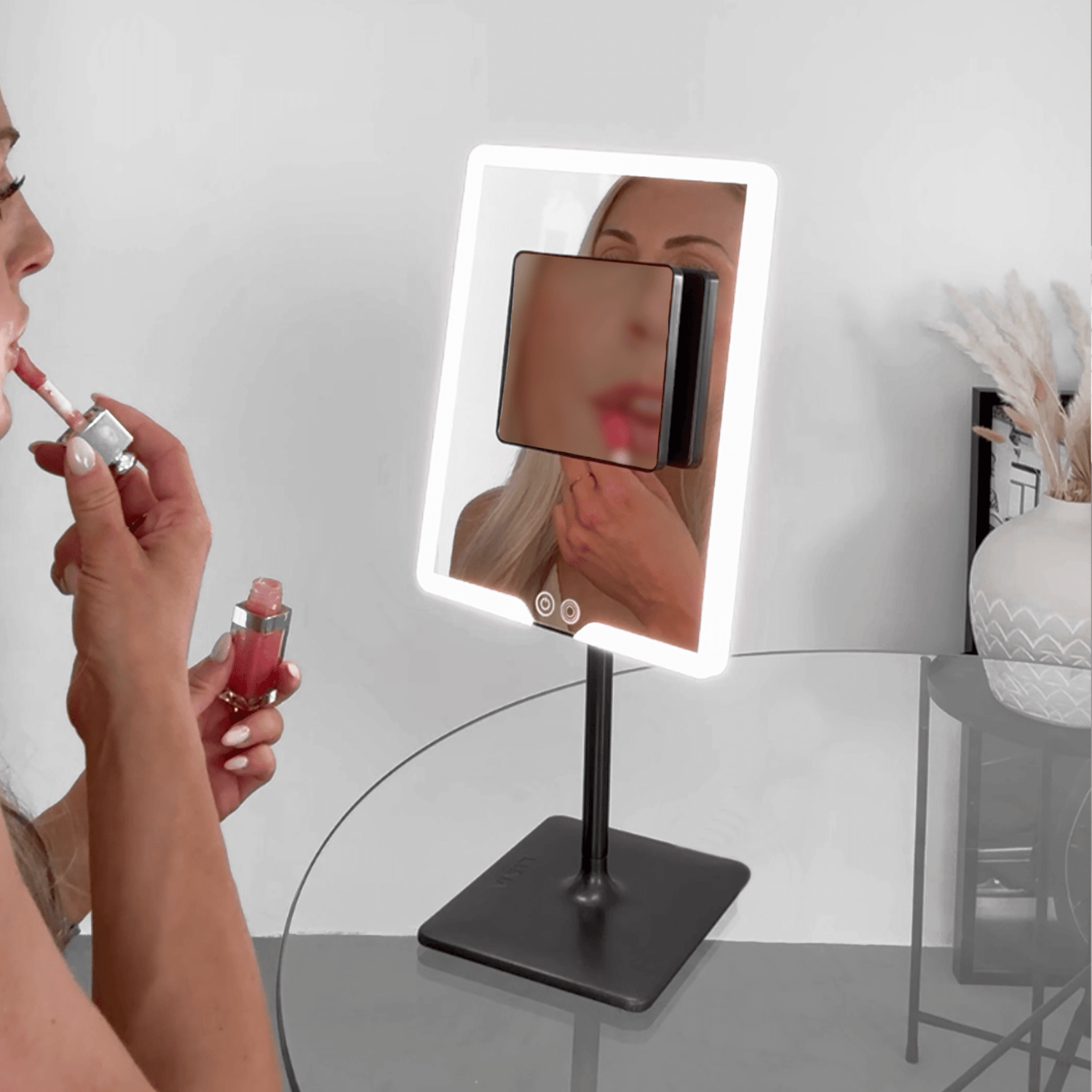
For ageing eyes, brows, contact lenses, shaving lines and close-up makeup checks, the useful upgrade is not extreme zoom. It is front-facing light, a realistic 1x view and a 7x magnification add-on when you need detail.


Magnification should support your routine, not turn it into microscope work. For lighting-first technique, see how better lighting fixes patchy foundation.
The trap: why stronger often leads to worse results
Strong magnification makes small imperfections look huge. That sounds helpful, until it changes your behaviour. People over-tweeze because one stray hair looks like five. People over-apply concealer because one pore looks like a crater. People shave too aggressively because they keep chasing a perfect edge that only exists at 15x.
If you want one rule that avoids most mistakes: plan in a realistic view, then check detail briefly. That means you do the main work in a normal 1x mirror with great lighting, then dip into magnification for final precision. This is also why a lot of 15x-as-your-main-mirror setups quietly fail.
“Many people don’t notice small vision changes and delay seeking help until their arms become ‘too short’.”
— Howard E. LeWine, MD, Harvard Health Publishing, July 2023
Ageing eyes: light first, then magnification
If you are 45 to 64 and close work has become annoying, your instinct might be “I need 15x”. Pause. Clinical guidance repeatedly highlights the same practical signs: you need more light and you hold things farther away. Harvard Health notes needing brighter light and holding reading material at arm’s length for clarity, and Cleveland Clinic describes the same pattern.
A more realistic approach is: upgrade lighting to reduce shadows and strain, then add moderate magnification only where it truly helps. This is why many people get better outcomes from a well-lit mirror plus moderate zoom than from an unlit, ultra-strong mirror.
⚡ PRO INSIGHT: If you are buying a magnifying mirror as a gift, especially for someone doing shaving, brows, contact lens handling or close-up makeup, prioritise bright even light, a realistic 1x view and optional magnification. It feels premium because it is easier to use, not because it is strong for the sake of it.
Where does 7x fit, and why it often beats the 5x/10x debate
Here is the awkward truth: a lot of shoppers search for 5x or 10x, but end up happiest with something in between, used briefly. That is exactly where 7x tends to sit: strong enough to make near work comfortable, but not as punishing as 10x or 15x when you are doing daily grooming.
In the LUNA range, ORBIT is your lighting-and-base-view anchor, and it includes a detachable 7x mini mirror stored in the base for close-up checks. For travel and on-the-go detail, COMPACT 2.0 provides 7x magnification in a portable format.
What about ECLIPSE? It is a lighting-first mirror without magnification. That matters because many “I need 10x” moments are actually “my lighting is rubbish” moments.
Pick the right setup by use case: makeup, shaving, tweezing, contact lenses
Instead of obsessing over a single perfect magnification, choose a setup that matches the jobs you actually do. Use this as a practical baseline.
| Use case | Recommended approach | Here’s Our Favourite |
|---|---|---|
|
Everyday makeup Symmetry matters |
Do 90% in a well-lit 1x view. Use moderate magnification only for final eyeliner and detail checks. |
ORBIT Daylight-style lighting for a realistic base view, plus a 7x mini for quick precision. |
|
Precision grooming Brows, stray hairs |
Plan shape in a realistic view, then zoom for a short confirm-and-stop check. |
ORBIT Pair it with the technique in how to pluck stray hairs without pain. |
|
Shaving and beard edges Men’s grooming |
Use even light to reduce shadow lines, then brief magnification to tidy edges. |
ORBIT Also see men’s grooming: best LED mirror for shaving and brows. |
|
Travel touch-ups Hotel lighting is brutal |
Choose portable lighting plus strong enough magnification for quick checks, not long sessions. |
COMPACT 2.0 7x for focused checks, without building a whole routine around extreme zoom. |
How to choose your magnification in 60 seconds
- Pick your main task. Full-face makeup? Brows? Shaving? That decides whether comfort or precision matters more.
- Set your normal distance. Stand how you actually stand. If you hate leaning in, do not buy a mirror that forces you to.
- Fix lighting first. If shadows are the issue, magnification only magnifies shadows. Consider a lighting-first mirror setup.
- Choose the lowest magnification that solves the task. For most people, that is 5x for daily detail and 10x only for quick checks.
- Keep a realism check. Always step back to 1x before you finish. That is how you avoid over-correcting.
If you want a deeper lighting comparison, this breakdown is worth skimming: vanity mirror with lights vs ring light.

For portable precision
COMPACT 2.0 gives you 7x detail without carrying a full vanity mirror
Use it for travel touch-ups, eyebrow checks, contact lens insertion and quick grooming on the go. It is the better fit when you need magnification away from the dressing table.
Quick technique video: use magnification for precision without turning your whole routine into microscope mode.
Common mistakes and the simple fixes
- Mistake: using 15x as your main mirror. Fix: use 1x for the overall face, then magnification briefly for checks.
- Mistake: blaming your eyesight when the lighting is the real problem. Fix: upgrade light, then reassess magnification.
- Mistake: over-tweezing or over-blending because the mirror is too intense. Fix: set a two-minute magnification limit, then step back.
- Mistake: leaning so close your posture wrecks your shoulders and neck. Fix: choose a setup that works at a distance you can repeat.
“Holding reading material further away… or struggling in lower lighting levels… is very normal.”
— Josie Evans, optometrist, Association of Optometrists, February 2024
If that line describes you, it is a signal to stop chasing extreme magnification and build a setup that reduces strain. For many people, that means better light, then moderate zoom.
One mirror, daily use
Upgrade the mirror check you use every day
ORBIT is the premium LUNA mirror for people who want proper lighting, a larger face view and 7x detail without cluttering the bathroom with separate tools.
“The light really helped in our darker bathroom.”

Quick tracked delivery available in:
 USA
USA
 UK
UK
 EU
EU
FAQs
Is 15x magnification too strong for normal makeup?
For most people, yes. 15x shows a tiny area at a time and exaggerates texture, so it can push you into over-correcting. It is best used briefly for a specific check, not for full-face makeup.
Is 5x or 10x better for everyday makeup and grooming?
For everyday use, 5x is usually the sweet spot because it balances clarity with comfort and field of view. 10x is better as a secondary mirror for short precision tasks like tweezing or lash placement.
Why do I have to get so close to see clearly in a high magnifying mirror?
Higher magnification typically demands a closer working distance and a smaller sweet spot where the image is sharp. If you dislike leaning in, choose lower magnification and improve lighting instead.
What is the best magnification for ageing eyes?
If close work is harder in your 40s to 60s, better light often helps more than jumping to extreme magnification. Many people find moderate magnification, often around the 5x to 7x range, more comfortable than 10x or 15x for daily routines.
Is 7x closer to 5x or 10x?
7x sits between them. It is stronger than a typical daily 5x, but usually more manageable than 10x when used briefly. In practice, it works best as a quick precision check alongside a realistic 1x view.
Do I need magnification if my lighting is good?
Maybe, but less than you think. Great lighting improves contrast and reduces shadow, so you may only need magnification for short detail checks, not as the foundation of your whole routine.
Related links
- Do I Need a Magnifying Mirror? A 7x Zoom Breakdown
- Daylight Makeup: Why Indoor vs Outdoor Light Changes Everything
- Vanity Mirror With Lights vs Ring Light: Which Is Better?
- How to Pluck Stray Hairs Without Pain
- Men’s Grooming: Best LED Mirror for Shaving and Brows
- ORBIT Phantom Black
- COMPACT 2.0 Rose Gold


Leave a comment
This site is protected by hCaptcha and the hCaptcha Privacy Policy and Terms of Service apply.