
Last updated: 27 May 2026
Where to Put a Bedroom Mirror When You Get Ready Standing Up
If you get ready standing up, a classic dressing table setup can feel slightly fake. Beautiful in photos, awkward at 7:42am when you are moving between wardrobe, bathroom, bed, mirror and door. The problem is not that your bedroom is too small or that you need a full vanity station. It is usually that your mirror is in the wrong place for the way you actually behave.
That is why bedroom mirror placement matters. A mirror hung too high makes you stretch. A mirror stuck in a dark corner makes foundation and under-eyes look wrong. A full-length mirror near clutter reflects the mess twice. A tiny tabletop mirror on a low chest forces you to hunch, lean and squint. None of this is glamorous, but it is exactly where everyday routines go bad.
The better question is not “where does a mirror look nice?” It is: where can you stand naturally, see your face clearly, reach what you use most, and check your final look before leaving the room? That is the setup worth building.
This guide is for anyone searching where to put a mirror in a bedroom, especially if you want a standing makeup setup or a simple vanity without a dressing table. It also builds neatly on our guide to building a vanity mirror with lights dressing table setup, without duplicating it. This one is more practical: no chair required, no fantasy furniture needed.

The best bedroom mirror placement, in one sentence
Place your main getting-ready mirror where your face is naturally lit from the front or side, where the mirror centre sits close to eye level, and where your most-used products sit within easy reach rather than across the room.
That sounds basic because it is. The trap is that people usually place bedroom mirrors according to wall gaps, sockets, wardrobe doors or aesthetics first. Then they blame the makeup, the lighting or their eyesight when the routine feels harder than it should.
⚡ PRO INSIGHT: If you stand up to get ready, test the mirror placement while holding the products you actually use. If you need to step sideways, bend down, lean in or turn away from the light for every small check, the setup is not working.
The easy standing setup: mirror, surface, light
A good standing makeup setup only needs three zones. First, the mirror itself. Second, a narrow surface for essentials. Third, lighting that falls on your face rather than behind your head.
The surface does not need to be a vanity table. It can be a chest of drawers, a slim console, a shelf beside a wardrobe, a window ledge, or the top of a small cabinet. The point is not to recreate a dressing room. It is to stop doing your routine while holding concealer, mascara and tweezers in one hand like a circus act.
For mirror height, use your own standing eye line as the starting point. The Canadian Centre for Occupational Health and Safety notes that standing workstations should be set close to elbow level depending on the task, with precision work generally higher than heavier work. That principle transfers neatly to bedroom routines: the more precise the task, the less you want to bend, reach or crane your neck. See their standing workstation guidance for the underlying ergonomic logic.
Bedroom mirror placement by routine
| How you get ready | Best mirror placement | What to avoid |
|---|---|---|
| Standing makeup | Mirror at face height above a narrow surface, ideally with side or front light. | A low tabletop mirror that makes you bend over every product. |
| Hair and outfit checks | Full-length mirror near the wardrobe or bedroom door, with enough distance to step back. | Putting the mirror where the bed blocks the full reflection. |
| Skincare and close-up grooming | Lit mirror on a chest, shelf or console where your face stays upright and close checks are easy. | Bathroom-only checks under harsh overhead light. |
| No dressing table | Use a portable mirror with lights on a chest of drawers, windowside shelf or wardrobe-adjacent surface. | Assuming you need a full vanity table before improving the setup. |
Use natural light, but do not worship it
Natural light is useful, but only if it hits your face cleanly. A mirror opposite or perpendicular to a window can help brighten a room by reflecting existing light, a principle also discussed by RMCAD in its overview of how mirrors influence light and space in interiors. OKA makes a similar point in its mirror advice, noting that a mirror opposite or beside a window can increase the amount of natural light cast around a room.
The mistake is placing your face between the window and the mirror. That gives you backlighting, which means your face falls into shadow while the room looks bright. Great for atmosphere, terrible for blending concealer. For makeup and grooming, you want light coming towards your face or softly from the side, not blasting from behind you.
If your only mirror-friendly wall is away from the window, do not panic. This is where a good makeup lighting setup matters more than furniture. For daily routines, front-facing, adjustable light is usually more useful than one dramatic overhead pendant.
Confidence before you buy
A proper mirror for routines where small details matter
“My hubby likes to use it when shaving as he finds the light really helpful as our bathroom is quite dark.”
The biggest mirror placement mistakes
1. Putting the mirror opposite clutter
A bedroom mirror doubles whatever it reflects. If it faces laundry, wires, makeup bags, open wardrobe doors or a busy corner, the room immediately feels less calm. That is not an interior design crime, just a self-inflicted annoyance. Put the mirror where it reflects light, wall space, a clean surface or a useful part of the room.
2. Hanging it too high
A decorative mirror can sit high if the aim is to fill a wall. A functional getting-ready mirror should meet your face. OKA’s mirror advice is blunt on this: if a mirror is functional, the centre should be in your eye line so you are not standing on tiptoe or crouching to use it. That is the difference between bedroom styling and bedroom utility.
3. Trusting overhead bedroom lighting
Ceiling lights are usually designed to light the room, not your face. They cast shadows under the brow bone, nose and chin. If you apply makeup there, you may over-correct areas that only look dark because the light is above you. Our vanity mirror with lights vs ring light comparison goes deeper on why mirror-aligned light is usually better for everyday accuracy than camera-style lighting.
“They create atmosphere in the bathroom... and they make your face look fab.”
The quote is about bathroom lighting, but the same logic applies in a bedroom. A mirror is not just a reflective surface. The light around it decides whether your reflection is useful, flattering or quietly misleading.
Where to put a mirror if you have no dressing table
A vanity without a dressing table works best when you stop thinking in furniture categories. You are not trying to buy a “vanity”. You are building a small task station.
The strongest no-dressing-table options are:
- On a chest of drawers: best for standing makeup, skincare and hair checks if the height is comfortable.
- Beside a wardrobe: best if your routine includes outfit decisions and final checks.
- Near a window, not directly backlit: best for morning makeup, provided your face still gets light from the front or side.
- On a slim console: best for narrow bedrooms or rental spaces where a full vanity table would dominate the room.
- On a shelf with a portable mirror: best for small bedrooms, shared spaces or anyone who wants the setup to disappear after use.
If you are using a portable mirror, choose one that is stable enough not to wobble every time you touch it. For close-up tasks such as brows, lashes, contact lenses or shaving lines, magnification can help, but more is not always better. Our guide to the best magnifying mirror for ageing eyes explains why sensible magnification and stable light usually beat extreme zoom.
⚡ PRO INSIGHT: The best standing setup lets you do the full routine without moving your feet more than once. Mirror, everyday products, bin, cotton pads and hair tools should sit in one small zone, not scattered across the room.
Do not make the bedroom too bright at night
There is one catch with bedroom mirror lighting: the light that helps your 7am routine can be the wrong light at 10:30pm. Sleep Foundation notes that light plays a central role in circadian rhythm and melatonin production, and that poorly timed artificial light can misalign the body’s day-night schedule. Its guidance on light and sleep is worth reading if your getting-ready area sits beside your bed.
So the rule is simple. Use brighter, clearer light for morning makeup and grooming. In the evening, use the lowest useful brightness and avoid turning your bedroom into a mini studio right before sleep. A portable, dimmable mirror helps because the light is task-specific rather than flooding the whole room.
Designed for where people actually get ready
ORBIT suits bedroom and standing routines beautifully
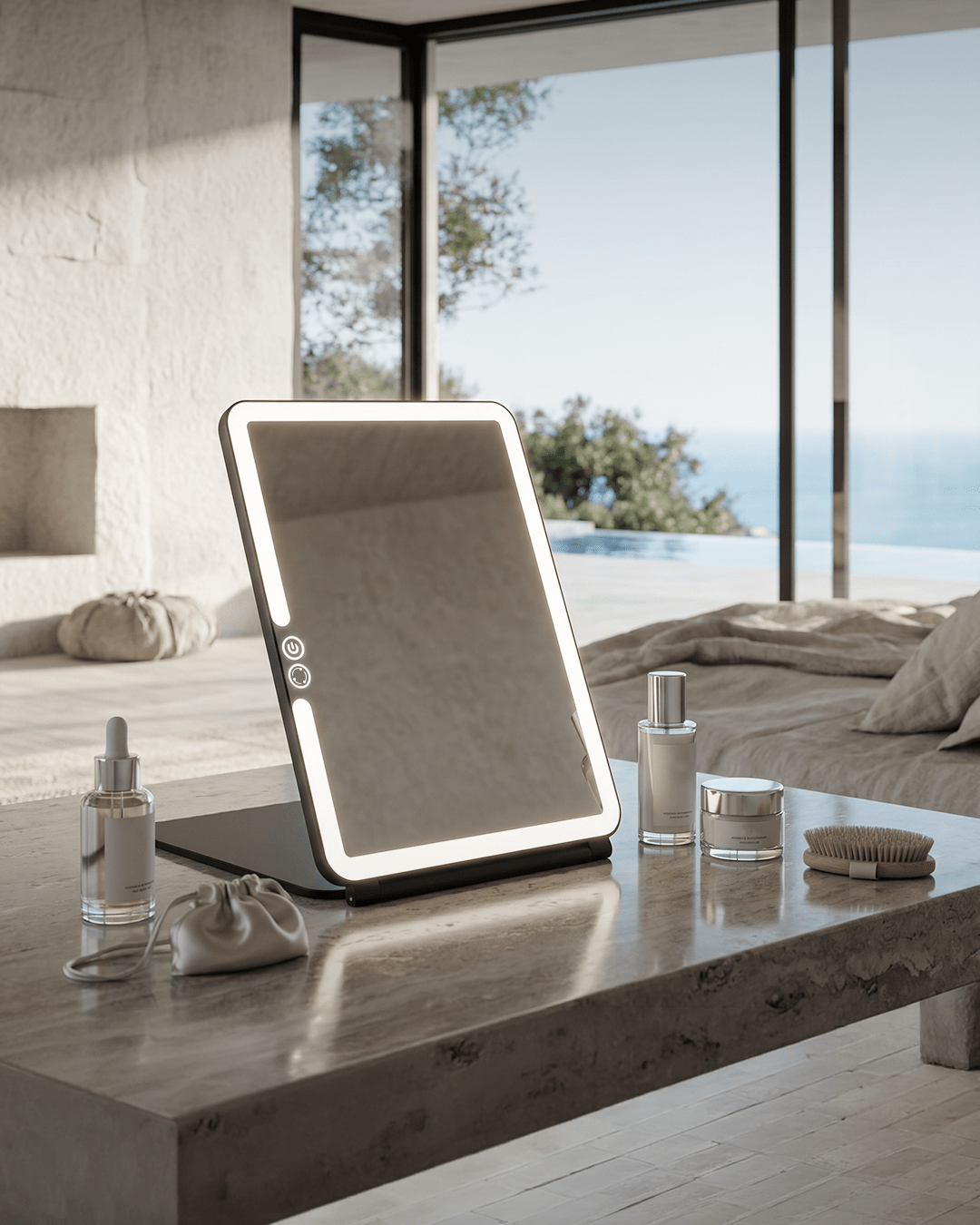
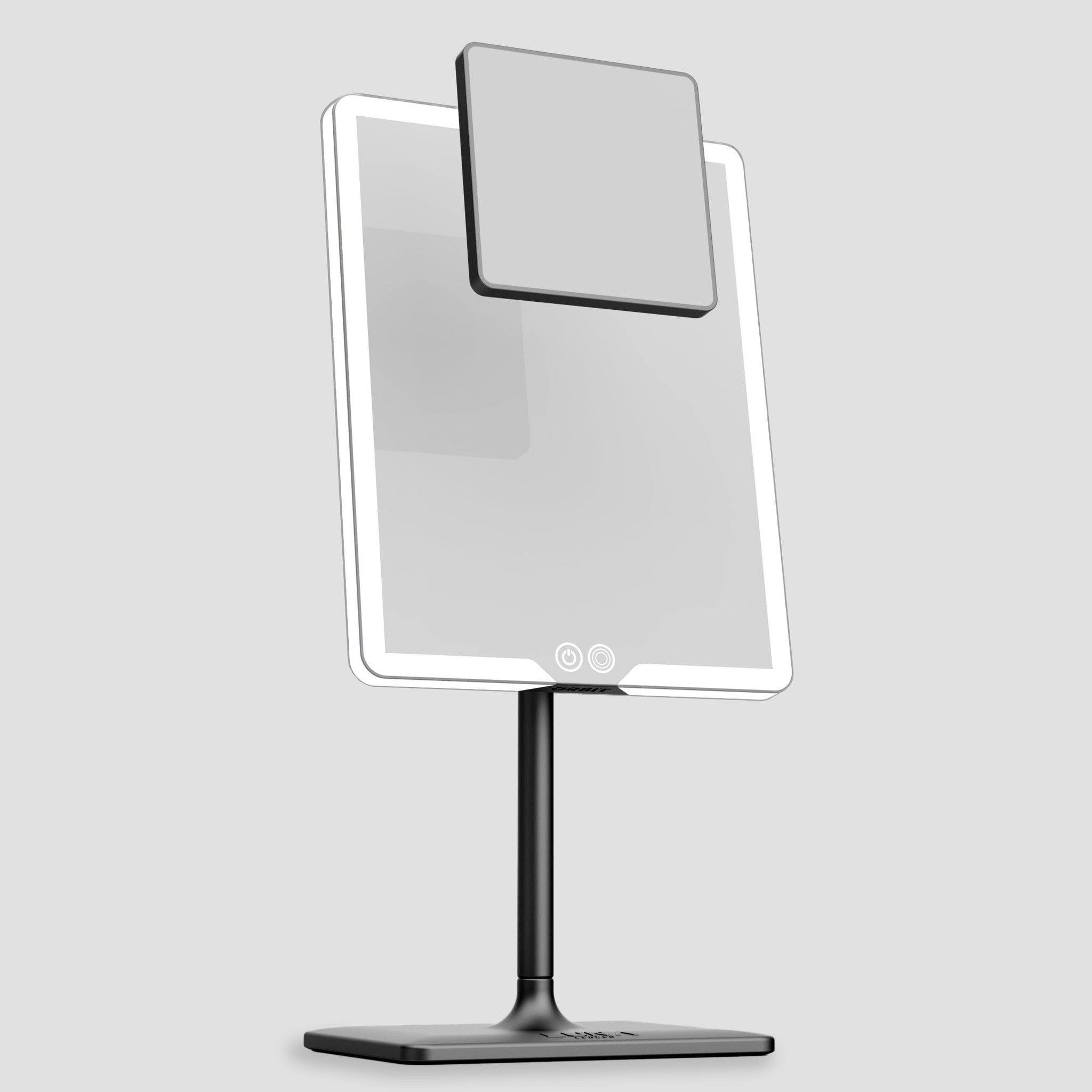
If your setup is a chest of drawers, shelf or wardrobe corner rather than a formal dressing table, ORBIT gives you a larger lit view, adjustable angles and a 7x magnification add-on for detail checks without forcing you to lean across the room.

The quick placement test before you move anything
Before drilling, buying or rearranging the room, do a five-minute test. Stand where you think the mirror should go. Hold your phone at face height in selfie mode if you need a temporary reflection. Then ask:
- Is my face lit clearly, or is the window behind me?
- Can I see my full face without crouching or standing on tiptoe?
- Can I place daily products within arm’s reach?
- Can I step back for outfit and hair checks?
- Does the mirror reflect something calm, or does it double the mess?
- Will this light annoy me at night if the bedroom is also where I sleep?
If the answer is mostly yes, you have your spot. If not, move the setup before you buy more storage, more makeup, or another decorative mirror that still does not solve the job.
Which LUNA mirror fits this setup?
For a bedroom mirror placement article, the natural hero is ORBIT, because it is designed as a stable vanity mirror with a larger face, adjustable angles, front-facing lighting and a 7x magnification add-on. But there are cases where ECLIPSE or COMPACT 2.0 makes more sense.
Choose by setup, not by guesswork
The easiest mirror choice for your bedroom routine
If you get ready standing up, match the mirror to the way you move. A full home setup needs stability and angle control. A lighter setup needs portability. A handbag setup needs close-up detail on the go.
| Mirror | Best for | Key features | Why it stands out |
|---|---|---|---|
|
ORBIT
|
Standing bedroom routines, skincare, brows, shaving and daily makeup. | Large 11 inch mirror face, 3 LED brightness settings, USB C rechargeable, 7x magnification add-on. | Shop ORBIT if you want the most complete bedroom setup. |
 ECLIPSE ECLIPSE
|
Small bedrooms, desk-drawer routines, travel and lighter touch-ups. | Fold-flat design, 3 LED brightness settings, USB rechargeable. No magnification. | Shop ECLIPSE if portability matters more than a full-size setup. |
 COMPACT 2.0 COMPACT 2.0
|
Handbag checks, contact lenses, lipstick edges, brows and quick precision. | 7x magnification mirror, 3 LED brightness settings, USB C rechargeable. | Shop COMPACT 2.0 if you want portable close-up detail. |
Final sanity check: do not buy around the room you wish you had. Buy around the routine you already do. If you get ready standing up, your best bedroom mirror placement is the one that keeps your face visible, your hands free, your light honest and your morning calmer.
Quick tracked delivery available in:
 USA
USA
 UK
UK
 EU
EU
FAQs
Where should a mirror be placed in a bedroom?
For a functional bedroom mirror, place it where you can stand naturally, see your face or full outfit clearly, and use available light without putting the window directly behind you. For makeup and grooming, a face-height mirror near a small surface is usually more useful than a decorative mirror hung high on the wall.
How do you create a vanity setup without a dressing table?
Use a chest of drawers, slim console, shelf or wardrobe-adjacent surface as your product zone, then add a stable mirror with front-facing light. The goal is not a full vanity table. It is a small, repeatable setup where mirror, light and essentials sit close enough to use without leaning or walking across the room.
Is it better to get ready standing up or sitting down?
Neither is automatically better. Sitting works well for longer makeup routines if you have a proper dressing table. Standing works better for faster routines, outfit checks, grooming, skincare and small bedrooms. What matters is that the mirror height, light direction and product placement match the position you actually use.


Leave a comment
This site is protected by hCaptcha and the hCaptcha Privacy Policy and Terms of Service apply.