
Last updated: 22 March 2026
In a hurry? TL;DR
- Choose a lighted makeup mirror with even face-framing light, not a harsh top light.
- For daily use, 1x plus occasional magnification is usually smarter than living in 10x all morning.
- Adjustable light warmth matters because bathroom light, office light and evening light are not the same.
- A stable tabletop mirror usually beats a flimsy portable one for everyday routines.
- If you do brows, liner, tweezing or contact lenses, a 7x detail option is genuinely useful.
How to Choose a Makeup Mirror You Will Actually Use Every Morning

Most people shop for a mirror the wrong way. They fixate on brightness, or they buy the biggest thing that fits the dressing table, or they assume more magnification must be better. In practice, the best makeup mirror for everyday use is the one that helps you make quick, accurate decisions at 7:15 a.m., not the one that looks most dramatic in a product grid.
That means four things matter more than the marketing copy suggests: light quality, viewing comfort, sensible magnification, and whether the mirror fits your real routine. If you do a full face most days, your needs are different from someone who just wants base, brows and mascara. If you wear contact lenses, do precision eyeliner, or are noticing near-vision changes, your setup needs to work harder.
It is also worth being honest about lighting. The U.S. Department of Energy notes that higher CRI reduces colour shift, while the Illuminating Engineering Society defines CRI as a measure of how much colours shift under a light source. That matters for makeup because a mirror can be “bright” and still make foundation, blush and concealer look wrong.
| What you need | What actually matters | What to avoid | Best fit |
|---|---|---|---|
| Daily base, bronzer, mascara | Even light, 1x view, stable angle | Tiny mirror face, one harsh light mode | Tabletop lighted mirror |
| Brows, liner, tweezing | Optional detail magnification, close control | Doing the entire routine under high magnification | 1x mirror plus 7x detail attachment |
| Contact lenses or ageing eyes | Clear light, easy angle changes, detail zoom | Single fixed angle, dim bathroom light | Larger tabletop mirror with optional 7x |
| Desk and dressing-table setup | Rechargeable, clutter-light footprint, reliable positioning | Bulky mirror with awkward cord placement | Cord-free adjustable mirror |
⚡ PRO INSIGHT: If your makeup often looks different when you leave the house, the problem is usually light quality or shadow placement, not your technique. A mirror that lights the face from the front is far more useful than a ceiling bulb behind you.
1. Light quality matters more than raw brightness
A bright mirror is not automatically a useful mirror. For everyday makeup, you want light that is even across the face, adjustable enough to mimic different settings, and calm enough that you do not end up over-applying just because your cheeks look shadowy.
That is why adjustable colour temperature is so practical. Warm light can flatter but hide mismatched base. Cooler daylight-style light is better for checking shade accuracy. A good everyday mirror lets you move between those scenarios, which is one reason a lighted makeup mirror usually outperforms a regular mirror in real routines.
If you spend a lot of time on screens before getting ready, comfort matters too. The American Academy of Ophthalmology recommends matching screen brightness to ambient light to reduce eye strain. The same principle applies to mirrors: if your mirror is glaringly brighter than the room, it can feel fatiguing rather than helpful.
2. The right size is “enough to see your whole face”, not “as big as possible”
Oversized vanity mirrors look impressive, but size alone does not solve daily-use problems. For most people, you need a mirror large enough to assess the whole face at normal distance, plus enough stability that it stays where you put it. That is it.
This is where many compact or ultra-cheap options fall apart. They are fine for emergency touch-ups, but not ideal for your main routine. If your mirror wobbles, tips, or makes you lean too close, it becomes irritating quickly. That is why a purpose-built tabletop design often wins for everyday use.
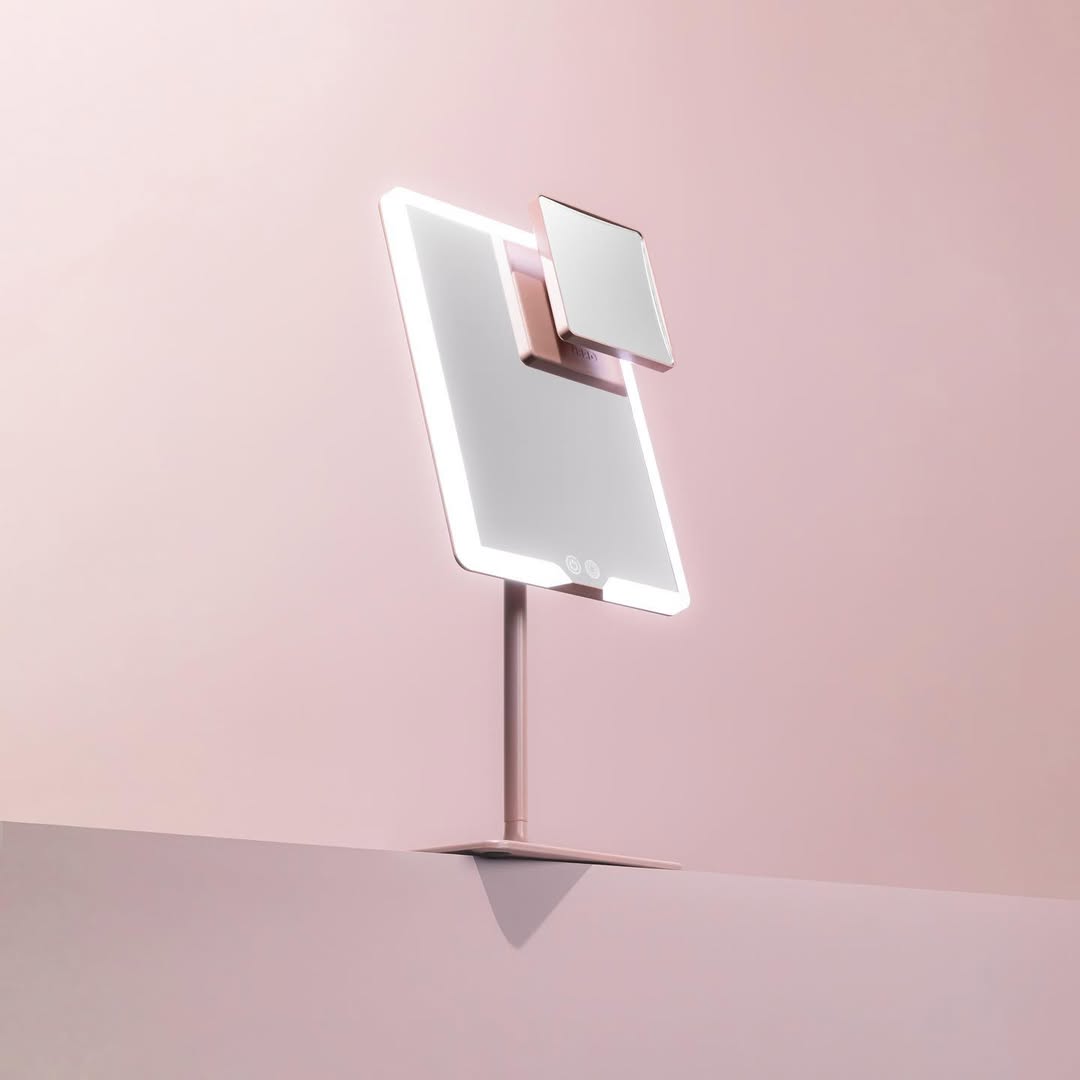
On LUNA’s side, ORBIT is strong here because it is designed as a stable, rechargeable tabletop mirror with a large 11-inch face and a detachable 7x add-on for detail work. That is a far more realistic everyday setup than forcing every step through one tiny magnified circle.
3. Magnification is helpful, but only when you use it like a tool

Here is the lazy assumption: more zoom equals better makeup. It does not. High magnification is brilliant for short, precise tasks like eyeliner, brow shaping, contact lens insertion or checking whether concealer has gathered. It is far less useful for judging your whole face.
That is exactly why lower, task-based magnification usually makes more sense than living in 10x or 15x. For everyday use, a standard view plus optional detail zoom tends to keep makeup more balanced.
“Always use a magnifying mirror... it’s so good, it changes everything.”
— Trinny Woodall, beauty entrepreneur, Woman & Home (2024)
That quote lands because it reflects real life. Magnification is transformative when it helps you spot detail. It becomes counterproductive when it turns a normal face into a giant inspection project. If you are noticing age-related near-vision changes, the National Institute on Aging notes that improved lighting can help support independence and daily tasks. That makes a larger, well-lit mirror with optional magnification far more sensible than an ultra-strong zoom mirror alone.
⚡ PRO INSIGHT: Use 1x for base, blush and balance. Use 7x only for lashes, liner, tweezing or checking edges. That simple switch prevents the classic over-blended, over-corrected look.
4. Angle control and comfort decide whether you keep using it
Daily-use mirrors should not force you into one posture. If you have to hunch, crane your neck, or move the entire mirror to see your jawline, it is not doing its job. Good angle adjustment sounds boring, but it is one of the biggest differences between a mirror you use for years and one that ends up shoved into a drawer.
Detachable or tilting designs also help with practical tasks. If you want to do eyeliner one minute and check hairline blend the next, flexibility matters. That is one reason a dedicated vanity mirror often works better than a ring light for everyday makeup. Ring lights are built more for camera-facing light. A daily mirror needs to work for actual faces, actual bathrooms and actual rushed mornings.
| Mirror type | Best for | Weak spot | Here’s Our Favourite |
|---|---|---|---|
| Basic non-lit tabletop mirror | Bright rooms with excellent natural light | Unreliable in bathrooms, evenings and winter mornings | ORBIT Soft Stone, because adjustable lighting makes the setup more dependable day to day |
| Extreme magnifying mirror only | Quick detail checks | Poor for judging balance and whole-face makeup | ORBIT Phantom Black, because 1x and 7x can work together instead of fighting each other |
| Ring light plus regular mirror | Filming or content creation | Cumbersome for quick daily routines | A proper cosmetic light mirror setup is usually cleaner and calmer |
5. Daily routine friction is the silent deal-breaker
People rarely return mirrors because of one spec. They stop using them because the setup is annoying. Too heavy. Too small. Too bright. Too weak. Needs plugging in at the wrong side. Makes them lean in. Makes them overdo makeup.
If you wear contact lenses, hygiene and visibility matter as well. Cleveland Clinic advises putting contacts in before applying makeup, which is a small but real reminder that an everyday mirror should support precision tasks cleanly and comfortably, not add more faff.

So, what is the best makeup mirror for everyday use?
For most people, it is a lighted makeup mirror with an accurate 1x view, adjustable light settings, stable positioning, and optional magnification for detail tasks only. That is the sweet spot between comfort and precision.
If your routine is mostly base, brows, mascara and quick checks before work, a mirror like ORBIT makes sense because it is built for repeated daily use rather than occasional touch-ups. You get the larger everyday view first, then the 7x attachment when you actually need it. That is a better everyday workflow than either a plain mirror with bad room lighting or an aggressive magnifier that turns every pore into a project.
If you want a deeper read on precision tasks, this guide on 7x setups is useful, especially for brows, contact lenses and ageing eyes.
A calmer everyday setup for base, brows and detail work
If you want one mirror that works for full-face makeup most of the time, but still handles tweezing, liner and contact-lens moments, ORBIT is the practical all-rounder. The larger 1x view keeps your makeup balanced, while the 7x attachment is there when precision actually matters.
Explore ORBIT for everyday use →FAQs
What is the best makeup mirror for everyday use?
The best everyday mirror is usually a stable lighted tabletop mirror with even front-facing light, adjustable colour temperature, and a normal 1x view. Optional magnification is useful, but it should support detail work rather than dominate the whole routine.
Is a lighted makeup mirror better than a regular mirror?
Usually, yes. A regular mirror depends entirely on your room lighting, which is often the weak point. A lighted mirror gives you more consistent visibility for base matching, blending and symmetry checks.
Do I need magnification for daily makeup?
Not for every step. Most people only need magnification for brows, liner, lashes, tweezing or contact lenses. For full-face makeup, 1x is the better judge of balance and proportion.
What light colour is best for daily makeup?
Neutral to daylight-style settings are usually best for checking foundation and concealer accuracy, while warmer settings can be helpful for evening looks. The key is having options rather than being stuck with one tone.
How big should an everyday makeup mirror be?
Big enough to see your whole face comfortably at normal distance. You do not necessarily need the biggest mirror on the market, but you do need enough surface area that you are not constantly leaning in and readjusting.
Is a ring light better than a vanity mirror for daily use?
Not usually. Ring lights are more useful for filming and content creation. For actual daily makeup, a mirror with integrated face-framing light is normally faster, calmer and easier to use.
Which LUNA mirror is best for everyday use?
For a home setup, ORBIT is the strongest everyday-use option because it combines a larger main mirror, adjustable lighting and a 7x attachment for detail tasks. ECLIPSE is more travel-focused and does not have magnification.
Related links
- ORBIT Phantom Black
- Vanity Mirror With Lights vs Ring Light: Which One’s Better for Everyday Makeup?
- Best Magnification for Makeup & Grooming: 5x vs 10x vs 15x
- Best Magnifying Mirror for Elderly: 7x + Lighting Tips
- Best Cosmetic Light Mirrors 2025: Buyer’s Guide


Leave a comment
This site is protected by hCaptcha and the hCaptcha Privacy Policy and Terms of Service apply.