
Last updated: Monday 7 September 2026
Mirror vs Camera Face: Which One Actually Shows the Real You?
In a hurry? The honest answer:
- Your mirror is not changing your facial proportions, but it does show a left-right reversed version.
- A close selfie can physically distort proportions, particularly the nose and middle of the face.
- The camera is not automatically more truthful just because the image is not reversed.
- The closest simple test is a photo taken from farther away, at roughly eye level, in even light.
- If one bad selfie suddenly makes you question your whole face, the selfie deserves more suspicion than your face does.
Why Your Reflection and Your Phone Can Show Two Surprisingly Different Faces
There is a strange little modern ritual most of us have experienced. You look perfectly normal in the mirror, open the front camera, take one photograph and suddenly wonder whether your nose, jaw, eyebrows or entire face changed in the previous six seconds.
It did not. The problem with the usual mirror vs camera face debate is that it treats both images as neutral recordings. Neither is. A mirror reverses your orientation. A camera converts a three-dimensional face into a flat image, and its result changes with distance, angle, lighting, processing and perspective.
So the useful question is not simply ‘do mirrors show the real you?’ It is: which viewing setup introduces the least misleading information?
| What you are looking at | What it gets right | What can mislead you | How honest is it? |
|---|---|---|---|
| Normal mirror | Proportions, movement, depth cues and viewing distance | Left-right reversal and whatever lighting the room gives you | Very useful for proportions |
| Front-camera selfie | Shows a photograph rather than a reflection | Close-distance perspective, wide field of view, angle and image processing | Often the least reliable |
| Rear camera from farther away | Non-reversed orientation with less close-range distortion | Still depends on lighting, height and processing | Usually the best simple camera test |
| Another person seeing you | They see you in depth, moving, from changing distances and angles | Human perception is not a frozen photograph either | Real life cannot be reduced to one frame |
Why Phone Selfies Can Change the Shape of Your Face
The biggest culprit is distance. When your phone is only an arm's length from your face, the parts closest to the camera are proportionally closer than the parts farther away. Your nose is closer to the lens than your ears, for example, so perspective can exaggerate the centre of the face.
A 2024 study on facial photography found measurable mid-face distortion when smartphone photographs were taken at short selfie distances. At around 8 inches, smartphone images showed an 18% increase in vertical mid-face stretching, while photographs at 12 inches still showed a 12% increase. You can read the research via PubMed.
Earlier modelling reached the same basic conclusion from another direction. Researchers studying short-distance photographs found that taking an image around 12 inches from the face could substantially exaggerate the apparent size of the nose relative to the rest of the face. The important part is not the exact percentage for your face. It is the principle: camera-to-face distance changes perspective.
⚡ PRO INSIGHT: Moving the camera farther away usually matters more than obsessing over which phone lens is supposedly the most flattering. Distance changes perspective. Zooming or cropping afterwards can restore the framing without forcing the camera back towards your face.
But the Mirror Is Reversed. Does That Make It Fake?
No. Reversal and distortion are not the same thing.
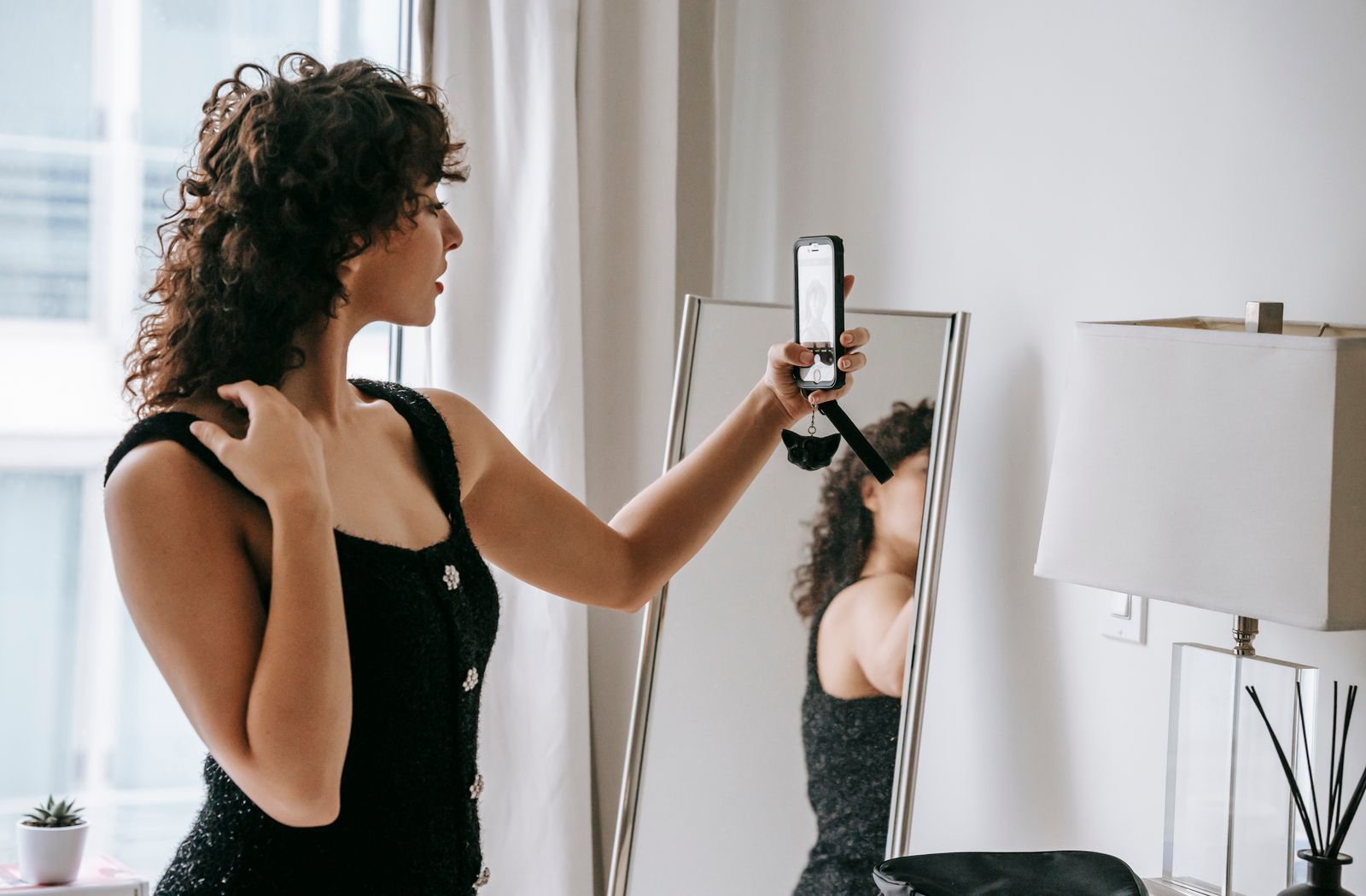
A flat mirror swaps the apparent left-right orientation of your face, which is why text appears backwards and why your hair part seems to jump sides in an unmirrored photograph. But the mirror is not suddenly making your nose larger because you moved your hand twelve inches closer to a lens.
The stranger part is familiarity. You have probably seen your reflected face thousands of times more often than the non-reversed version. Small natural asymmetries therefore sit where your brain expects them to sit. Flip the image and nothing may be objectively wrong, yet it can feel subtly unfamiliar.
That is one reason a normal photograph can feel ‘off’ while looking completely ordinary to everyone else.
“Selfies may not reflect an individual's true appearance.”
— Dr Bardia Amirlak, Associate Professor of Plastic Surgery, UT Southwestern Medical Center
So Which One Looks More Like What Other People See?
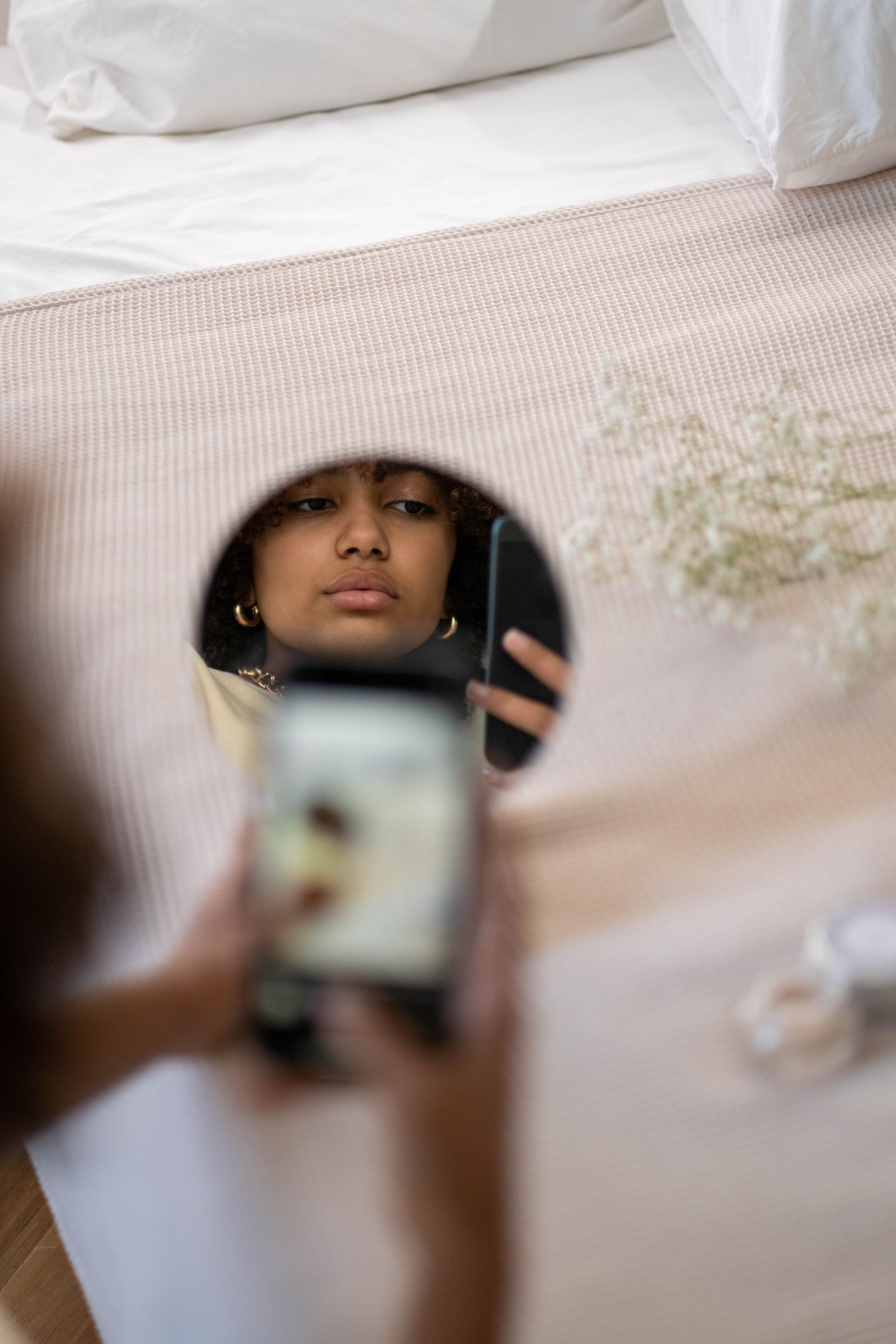
If we have to pick between a normal mirror and a close front-camera selfie, the mirror usually gives you the more useful impression of your facial proportions. Other people do not see the left-right reversal, but they also do not normally inspect your face through a wide phone camera held thirty centimetres away.
Real human vision is also dynamic. Someone talking to you sees your face moving, turning and changing expression. They see depth. Their viewing distance changes. They do not freeze one millisecond, enlarge it to fill a screen and scrutinise one eyebrow.
That is why the phrase ‘the camera never lies’ is particularly unhelpful here. Cameras record. They also translate.
The closest practical approximation
If curiosity gets the better of you and you want a fairer comparison, use this simple setup:
- Use the rear camera if possible. You do not need the convenience of a close front-facing selfie.
- Move the phone roughly 1.2 to 1.5 metres away. Use a timer or ask someone else to take the photograph.
- Keep the camera around eye level. Avoid holding it above your forehead or below your chin.
- Stand in soft, even light. A window in front of you or balanced front-facing light is far more useful than a single harsh ceiling bulb.
- Turn off obvious beauty filters and portrait reshaping.
- Compare several frames, not one. Your face is an animated object, not a passport photograph.
For anyone who uses makeup, the lighting part matters even more. LUNA's guide to warm, cool and natural light for makeup explains why the same complexion can read differently under different colour temperatures. If your makeup specifically falls apart outside the bathroom, this guide to makeup mistakes under bad lighting tackles that problem directly.

When consistency matters
A stable mirror beats chasing a flattering angle
The point is not to find the version of your face you like most. It is to remove variables. ORBIT gives you a fixed mirror position, controlled front-facing light and a 7x magnification add-on for brows, lashes or fine detail, then lets you return to the full-face view.
The Video Version: Watch Selfie Distortion Happen
This short demonstration is useful because the effect is easier to understand when you see the camera position change rather than just reading about focal length and perspective.
Lighting Can Make the Difference Look Even Bigger
Camera perspective gets most of the attention, but lighting can make two otherwise accurate views feel radically different.
Overhead light deepens shadows beneath the eyes, nose and chin. Light coming from below can reverse those shadows. Warm light may soften colour differences, while a cooler or more neutral source can make texture and redness easier to see. A phone camera then makes its own exposure, sharpening and processing decisions on top.
This is why comparing your face in a softly lit bedroom mirror with a front camera under a ceiling spotlight is not a controlled experiment. You have changed almost every variable at once.
If you want the deeper lighting side of this, read LUNA's everyday makeup mirror guide or the more technical piece on colour rendering and mirror lighting.

⚡ PRO INSIGHT: If you are comparing your face or makeup between mirror and camera, keep the light constant first. Otherwise you may blame the camera for a shadow problem, or blame the mirror for a colour-temperature problem.
Four ‘Real Face’ Tests That Are Mostly Useless
1. Holding two mirrors together to un-reverse your face
It can show a non-reversed orientation, but that does not suddenly recreate another person's full three-dimensional perception of you. Interesting experiment, not an objective truth machine.
2. Judging yourself from one front-camera photograph
This is probably the worst option. Short distance, frozen expression, phone processing and possibly poor lighting all arrive at once.
3. Zooming into a magnifying mirror and judging your whole face
Magnification is useful for a task, not for evaluating overall proportions. Use it to see an eyeliner edge or stray hair, then step back to normal view.
4. Assuming the least flattering version must be the most honest
This is surprisingly common logic and it makes no sense. Harshness is not accuracy. A distorted photograph is not made more truthful because you dislike it.
The Bottom Line: Mirror or Camera?
Your mirror is not exactly what other people see because it is reversed, but a close selfie is often less representative of your actual facial proportions.
If you want the fairest static image, move the camera farther away, keep it near eye level and use even lighting. If you simply want to get ready, groom or apply makeup accurately, a normal mirror with consistent face-level lighting is usually a much more useful tool than repeatedly checking the front camera.
And perhaps the most important point: there is no single frozen image that perfectly represents ‘the real you’. People see a moving three-dimensional face from many distances and angles. Your least favourite selfie does not get special authority just because it came from a camera.

A more consistent daily view
Stop changing the angle. Change the setup.
“The light really helped in our darker bathroom.”
ORBIT is built for the boring thing that actually helps: a stable full-face view, front-facing light and optional 7x detail when a task calls for it. No phone balancing, no leaning over the sink, no judging your face through one close selfie.
Shipping available to:
 USA
USA
 UK
UK
 EU
EU
FAQs
Do mirrors show the real you?
A normal flat mirror gives a useful representation of your facial proportions, but it reverses the apparent left-right orientation. Other people see the non-reversed version of your face, in three dimensions and from constantly changing angles rather than as one frozen reflection.
Is a phone camera more accurate than a mirror?
Not automatically. A close front-camera selfie can distort facial proportions because of perspective and camera distance. A photograph taken farther away, around portrait distance, with the camera near eye level and even lighting is a much fairer comparison.
Why do I look better in the mirror than in photos?
Your mirror image is extremely familiar to you, while an unmirrored photograph reverses the asymmetries you are used to seeing. Photos also introduce camera distance, angle, lighting and processing, so the difference is not simply that one image is ‘real’ and the other is not.


Leave a comment
This site is protected by hCaptcha and the hCaptcha Privacy Policy and Terms of Service apply.